
Choose a portable gas detector by naming the gas, locating the air you need to test, and deciding how that air will reach the instrument. Then compare the exact sensor and sampling configuration you can order.
A wearable monitor reads the air at its inlet as the worker moves. A pumped instrument can draw a sample from a probe or tube inlet away from the operator, provided that the complete sampling arrangement suits the target gas. A handheld leak-search instrument addresses another task again. Write down the gas and range, the sampling point, and the required alarms before choosing a model.
- 1. Name the gas
- 2. Locate the sample
- 3. Choose the sampling path
- 4. Confirm the ordered version
If you are choosing a monitor to be worn during a shift, start with the personal monitoring branch below. If the sample must come from a chamber, well or other position beyond the operator’s reach, go to remote checks and then the sampling-path section. If the work is to trace a suspected leak at an accessible valve or connection, read the leak-search branch. These tasks may occur on the same job, but their sampling points are different.
Start with the gas, not the detector
Identify the gas and the work that could release it
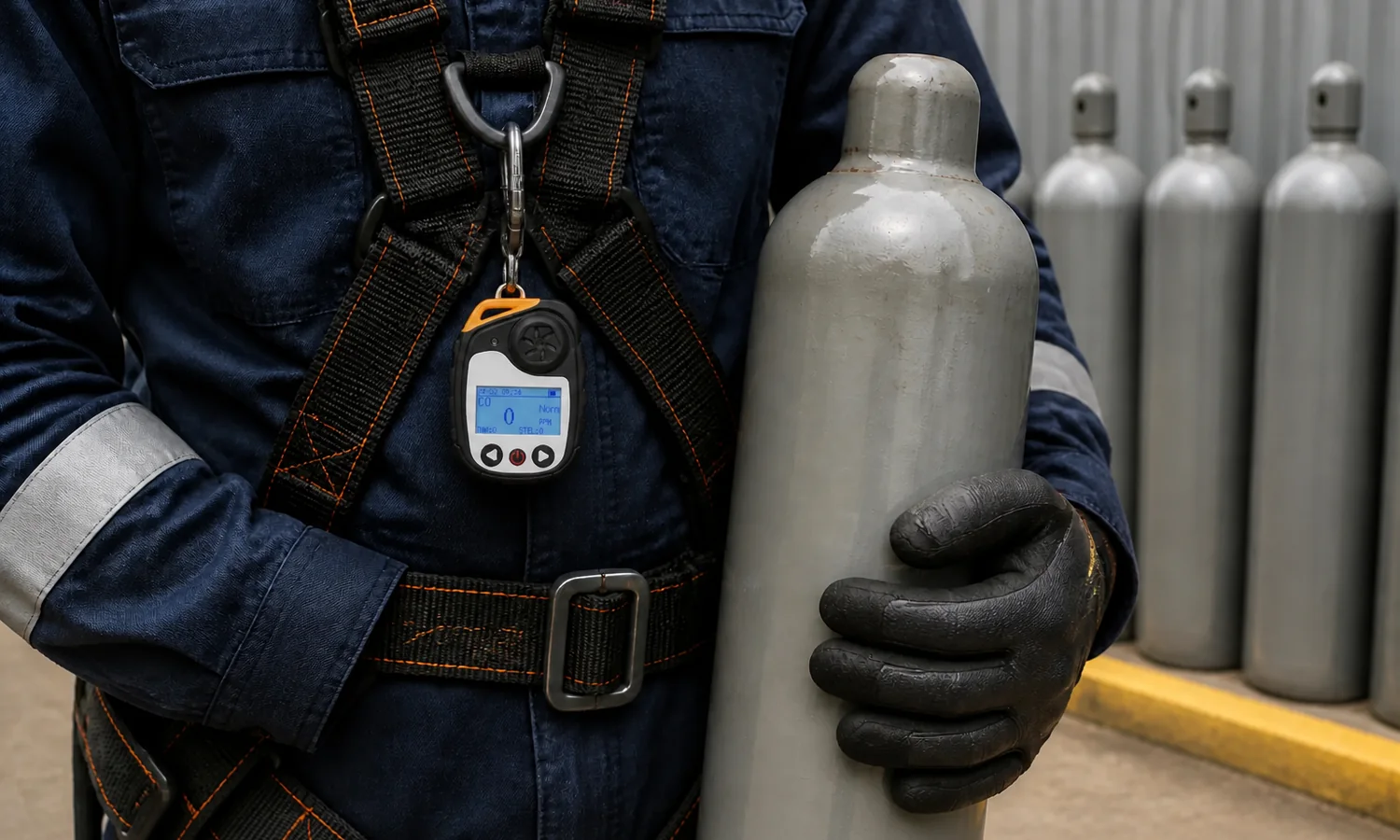
Begin with the process material, its storage or transfer point, and the work being done. A wastewater access point, a gas-cylinder change and a pipeline joint inspection do not produce one universal sensor list. Even within one site, the relevant gases can change with the material in a line, the cleaning agent used, or the area being entered. Record each gas that the task calls for the instrument to measure, rather than starting with a catalogue description such as “four-gas detector.”
Also state whether the question is about oxygen level, combustible gas, a named toxic gas, or several of these at once. If the material or the possible contaminants have not been identified, the model choice is premature. The first useful output is a gas list that someone familiar with the process can check.
Match the installed channels and range
A product family may offer many sensors without carrying all of them in one unit. For each candidate, ask which sensors will be installed in the instrument supplied, whether they can operate together, and what range and resolution will appear for each channel. G60 can be configured with one or more gas sensors. Specify the gases, ranges and options needed for your order. Even when choosing a single-gas unit, confirm which gas sensor will be fitted.
Keep the measurement unit next to the range. A toxic-gas reading in ppm, an oxygen concentration in %vol, and a combustible-gas reading in %LEL describe different quantities. A number without its gas and unit is not useful for comparing devices or setting up an alarm. The range also has to suit the measurement purpose; a broad range and a low-level investigation may call for different choices.
Ask what else can affect the reading
Mixed atmospheres, other process gases, humidity, dust and the sampling arrangement can affect whether a sensor is appropriate. Check range, response time, environmental effects and possible interferences for the intended job; these are among the factors in NIOSH’s evaluation of direct-reading monitors. Do not assume every selectable gas can be fitted in the same unit or that one calibration applies to every target gas.
| Work point | Gas to check | Purpose | Range and unit | Other gases or conditions | Still to confirm |
|---|---|---|---|---|---|
| Underground access point | List the gases identified for this specific task | Atmosphere check before access; monitoring during work if required | Specify for each gas | Process history, ventilation and possible stratification | Sensor combination, sample position and sampling method |
| Valve or connection | Name the gas in the line | Find or investigate a suspected release | Specify for the leak-search task | Nearby materials and accessible probe positions | Sensor suitability and probe arrangement |
| Cylinder handling area | Name the cylinder contents | Monitor the handling task | Specify for that material | Other cylinders and work nearby | Personal or spot-check configuration |
The rows show how to record a requirement. They are not preset sensor combinations for every well, valve or cylinder room.
Choose the monitoring task
Personal monitoring near the wearer
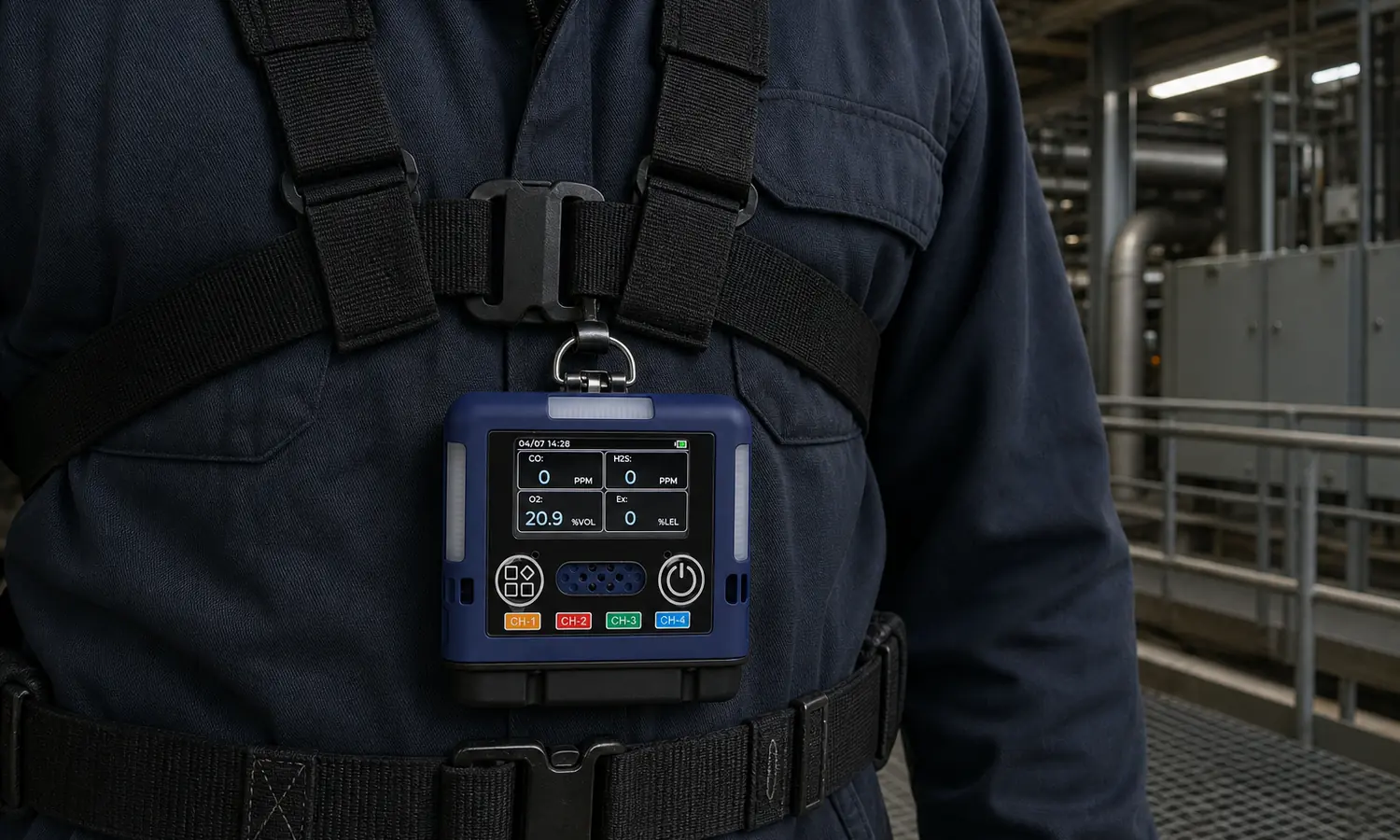
A personal monitor moves with the worker. Its inlet must remain exposed to the air at the intended wearing position, and the wearer must be able to notice its alarm while doing the job. A diffusion configuration measures the air at the instrument; it does not test a remote point merely because the worker can see that point. Decide whether one known gas channel is sufficient or whether the job’s gas list requires several fitted channels. Confirm the alarm and battery arrangements for the actual shift and ordered version.
Remote checks before the operator reaches the point
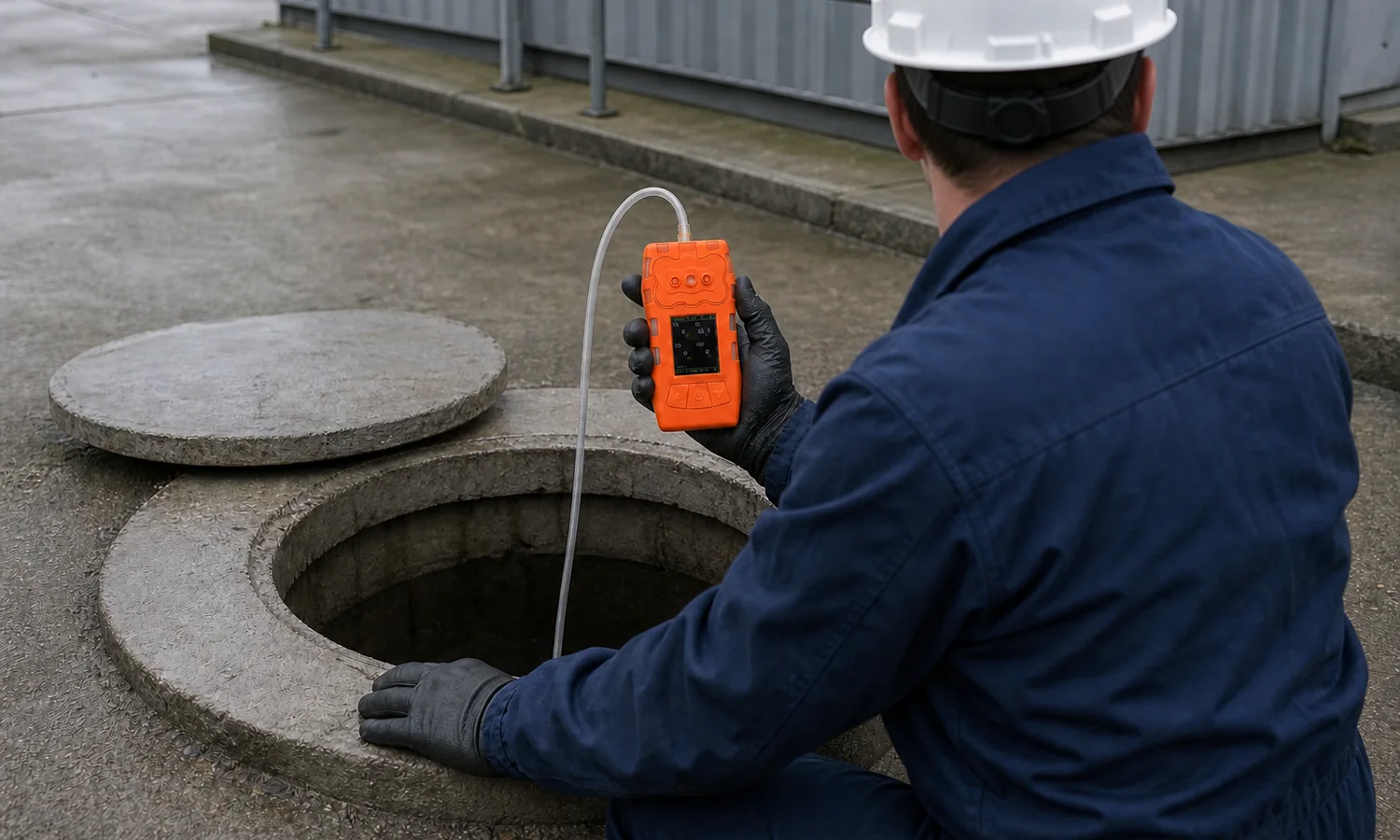
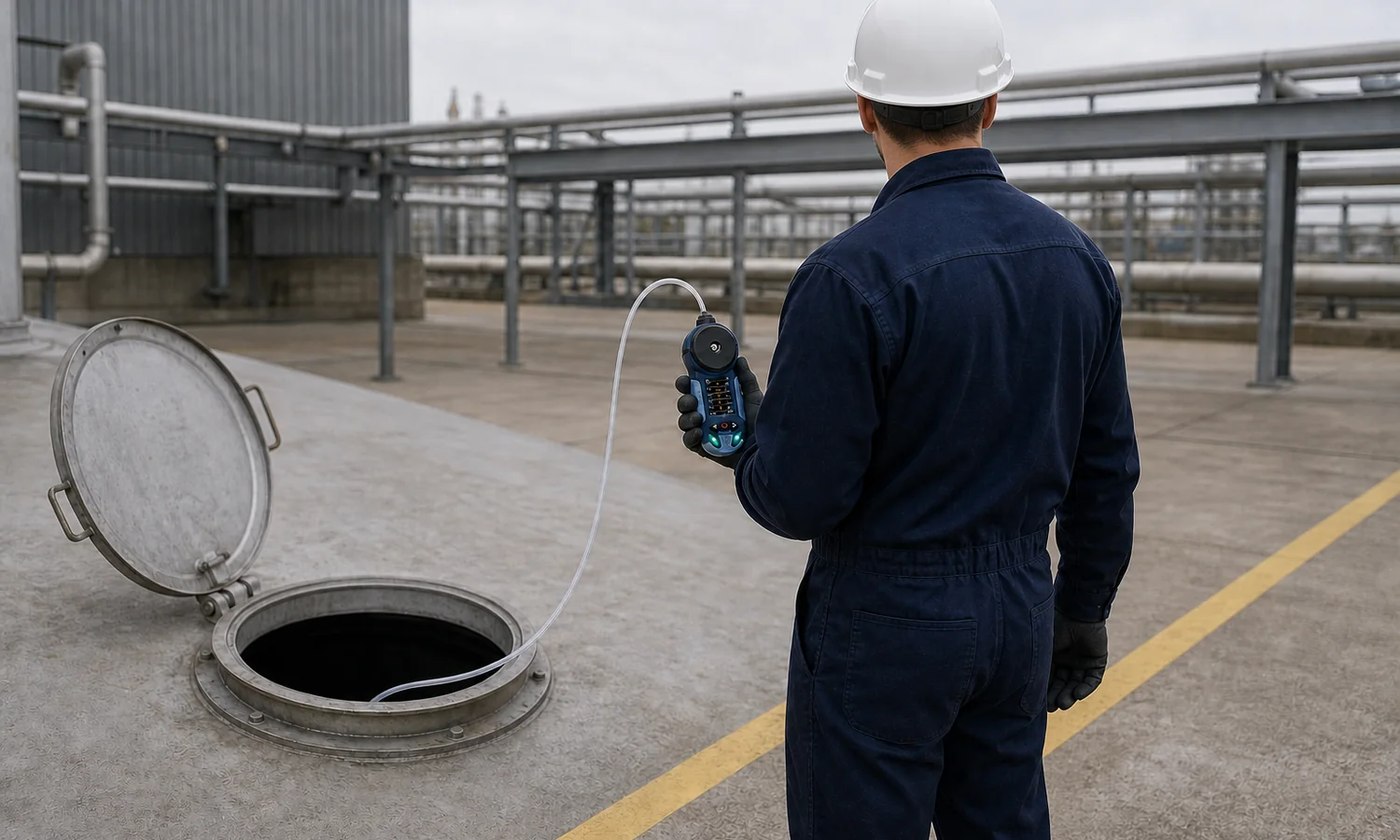
Where the question concerns air inside a well, chamber or other position away from the operator, write down the sampling inlet location first. A pump, probe or tube may be needed to bring that air to the sensor. The instrument, inlet, tube and target gas must be checked as one arrangement. A diffusion-only device placed beside the operator will report the air beside the operator, not the atmosphere at the far end of an imagined tube.
For a pre-entry check, record each position to be sampled, the gases to be checked and the time allowed for the sample to travel and the instrument to respond. If work will continue after entry, specify what will monitor the worker’s air during that work as a separate question. The pre-entry arrangement and the worn arrangement may use different configurations.
Targeted leak search at accessible equipment
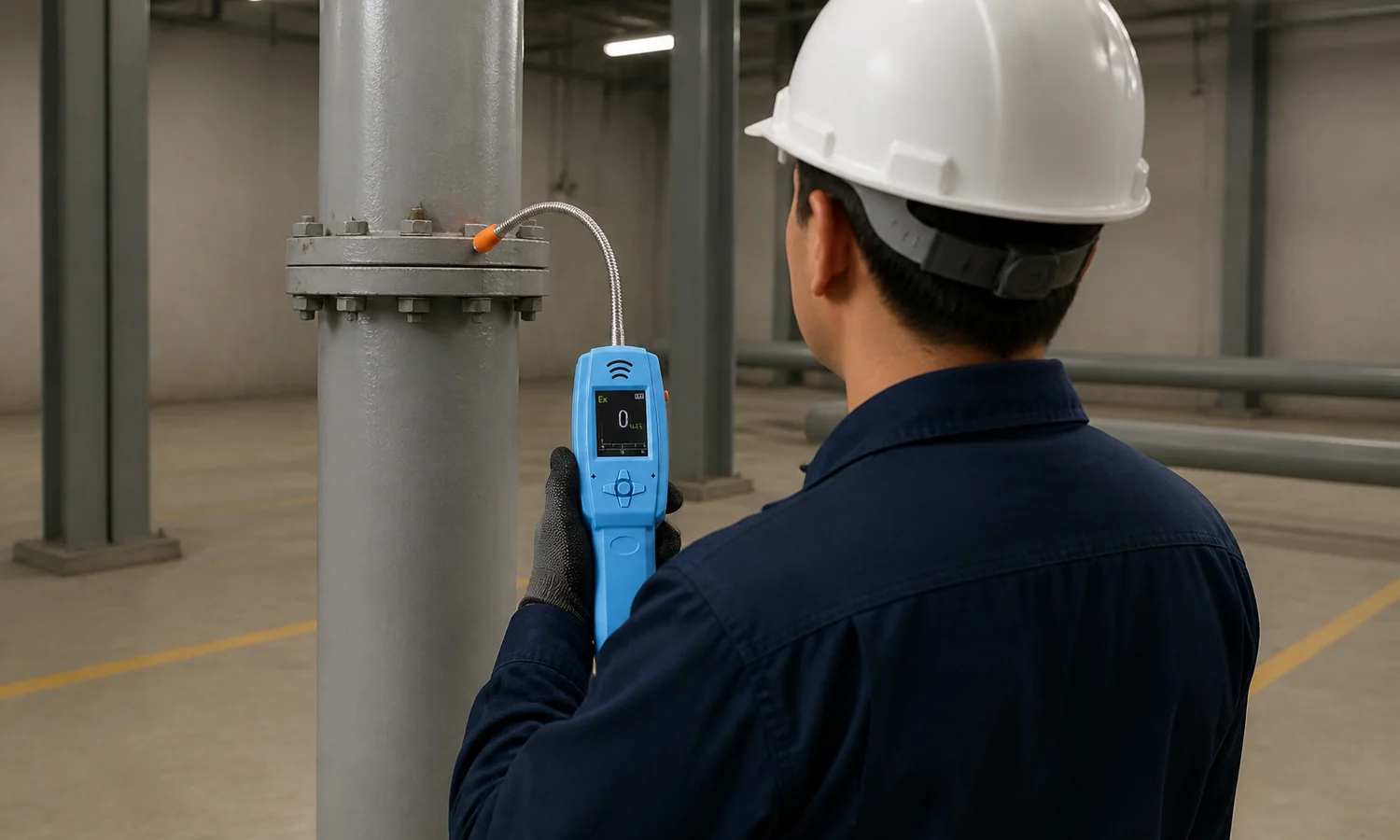
A technician looking along a valve, flange or joint needs an instrument suited to the named gas and to the physical search route. The inlet or probe has to reach the points being checked, and the operator needs a readable indication as the probe moves. That is different from carrying a monitor solely to watch the air around the person. Confirm the sampling method of the particular leak-search model before treating it as suitable for any location beyond arm’s reach.
| Task | Where is the air sampled? | Likely approach | Question to settle before ordering |
|---|---|---|---|
| Wearer monitoring | At the exposed inlet on the worn instrument | Diffusion, with fitted channels selected for the job | Which gases, alarms and operating duration are supplied? |
| Remote pre-check | At the probe or tube inlet | Pumped configuration with a specified sample path | Is the whole probe, tube and sensor arrangement suitable for the target gas? |
| Accessible leak search | At each point reached by the handheld inlet or confirmed probe | Gas-specific handheld search configuration | What is the actual sampling method and usable reach? |
| Pre-check followed by occupied work | Two distinct sampling positions | Specify both stages separately | Can one ordered configuration genuinely perform both, or are two needed? |
Underground access
Identify the gases from the site’s process and work history. Define the positions to sample from outside, then specify monitoring during the occupied task separately. Ask how the pump, tube and instrument will be checked together.
Cylinder change
Start with the contents of the cylinder being handled and any other materials nearby. Decide whether the task calls for a worn monitor, a check at the connection, or both. An industry label alone does not name the sensor.
Valve inspection
Name the gas in the pipe and map the joints that can be reached. A handheld leak search asks a different question from a personal monitor worn during the route. Check the actual inlet and probe configuration.
Diffusion or pumped sampling? Check the whole sample path
Diffusion reads air at the instrument
For a diffusion instrument, air reaches the sensor at the device inlet. This makes its position part of the measurement. A clipped-on monitor under clothing or behind a bag may not sample the air you intended it to sample. For a hand-held check, move the instrument’s inlet to the location of interest and allow the model’s response behaviour to guide how long it stays there.
A pump moves the sampling point
With pumped sampling, the relevant point is the probe or tube inlet. Between that point and the sensor lie the probe, tube, connections, pump and any filter. Sample travel time and leakage, absorption, corrosion or blockage along that path can change the reading; these issues are covered in UK HSE’s flammable-gas detector guidance. For another target gas, check the compatibility of its specific sampling path.
Tube material matters as much as tube length. In a UK HSE safety alert, the target vapour was retained by an unsuitable sample tube and did not reach the instrument during the test, even though the detector itself met its specification. That is a concrete reason to ask for the proposed gas, tube material, probe and test method as one specification. A successful response to a different calibration gas does not by itself establish the response to the target vapour through that tube.

Time the arrangement, not just the sensor
At each remote sampling point, allow time for the gas to travel through the tube and for the instrument to respond before recording a reading. Ask how long the proposed line takes to deliver a sample, then check the probe and line for leaks, kinks, wet filters or blocked inlets. Confirm that the tube material suits the target gas before specifying the pumped configuration for that work point.
Compare exact configurations, not model names
A shortlist becomes useful only when every line describes an orderable version. “Four gas” gives a channel count, not four named gases. “Wireless” does not say which network option is fitted or who receives an alert. “Pump available” does not establish whether it is inside the instrument, an accessory, or absent from the quoted package. Ask for a configuration sheet rather than comparing the longest feature lists.
Gas channels, ranges and sampling version
Put the target gas, range and unit in separate columns for each channel. Then add the sampling version and any required probe or tube. G60 uses natural diffusion; OT135S is available in natural-diffusion or built-in pump-suction configurations. Choose between them by the sampling point as well as the gas list. OT600 has a built-in pump and can be configured for one to six gases. Name the sensors required in the order.
Alarms, records and the working shift
Check how the worker will notice a gas alarm and a fault or low-battery warning. Confirm who sets and checks the alarm points for the ordered gases. If incident review matters, ask what the device stores, how those records are retrieved, and who will keep them. A stored record is not the same as a remote live alarm. Specify any required communications interface in the order; it may be optional.
Operating time belongs to the exact sensor, sampling and communications configuration. A pump, display or wireless option can change the practical duty cycle. Check the quoted version’s working-time information rather than copying a headline value from another version. Request the operating and maintenance documents that match the delivery.
| Candidate | Selection task | Sampling to specify | Gas configuration to confirm | Question for quotation |
|---|---|---|---|---|
| G10S | Selected-gas personal monitoring | Natural diffusion | Target gas and range | Which sensor and communication options are fitted? |
| G60 | Configurable multi-gas worker monitoring | Natural diffusion | Ordered channels, count and ranges | What records and export options are supplied? |
| OT135S | Configurable personal or remote-check task | Diffusion or pump-suction version | One to four selected gases, subject to compatibility | Which version, probe and tube are in the package? |
| OT600 | Pumped multi-gas sampling | Built-in pump; specify accessories | One to six selected gases | Which probe, line and sensor set are supplied? |
| OT131 | Handheld search at accessible leak points | Confirm before specifying remote use | Target gas and range | What is the verified sampling method and reach? |
This is a task comparison, not a ranking of measurement performance. Blank configuration details must be answered for the actual order.
Otywell portable detector options by task
Choose by where the air must be sampled and which gases must be measured. Confirm the fitted sensors, sampling version and accessories in your quotation.
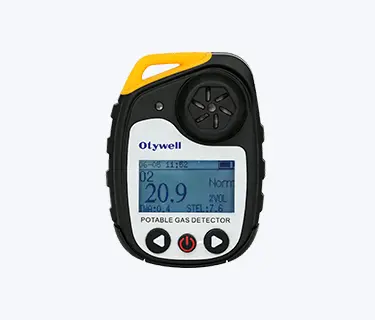 Personal · selected gas
G10S Portable Gas Detection Alarm
Natural-diffusion monitoring with the target gas and range selected for the work. Confirm fitted sensor and optional communication.
View G10S details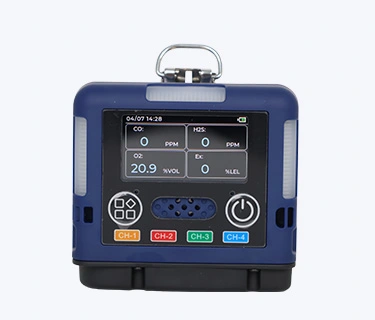 Personal · multi-gas
G60 4 in 1 Multi-Gas Detector
Configurable diffusion monitor for selected gas channels. Confirm the supplied combination and record-export options.
View G60 details
OT135S Portable Gas Detection Alarm
Configurable for one to four selected gases, with diffusion or pump-suction versions. Specify the version and sampling accessories.
View OT135S details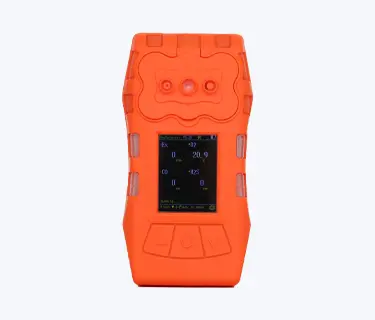 Pumped sampling
OT600 Pump-Suction Detector
Built-in pump with one to six selected gas channels. Confirm the actual gas set, probe and line for the sampling job.
View OT600 details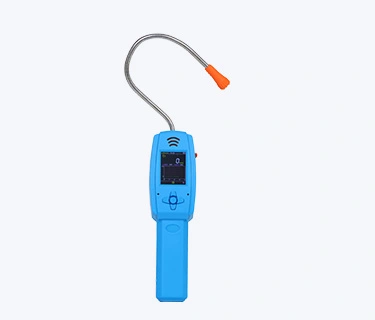 Leak search
OT131 Handheld Gas Leak Detector
Handheld option for checking accessible suspected leak points. Confirm the target gas, range and sampling method.
View OT131 detailsWhat to check before the first shift
Inspect the actual instrument and sampling kit
Check the model and fitted gas channels against the job sheet. Look at the battery state, display and local alarm indicators. Inspect the inlet and any probe, tube, filter and pump for damage or obstruction. If a tube is part of the measurement, verify the complete path in the configuration in which it will be used. A damaged probe, blocked inlet, depleted battery or display fault can prevent a usable reading.
Distinguish a function check from calibration
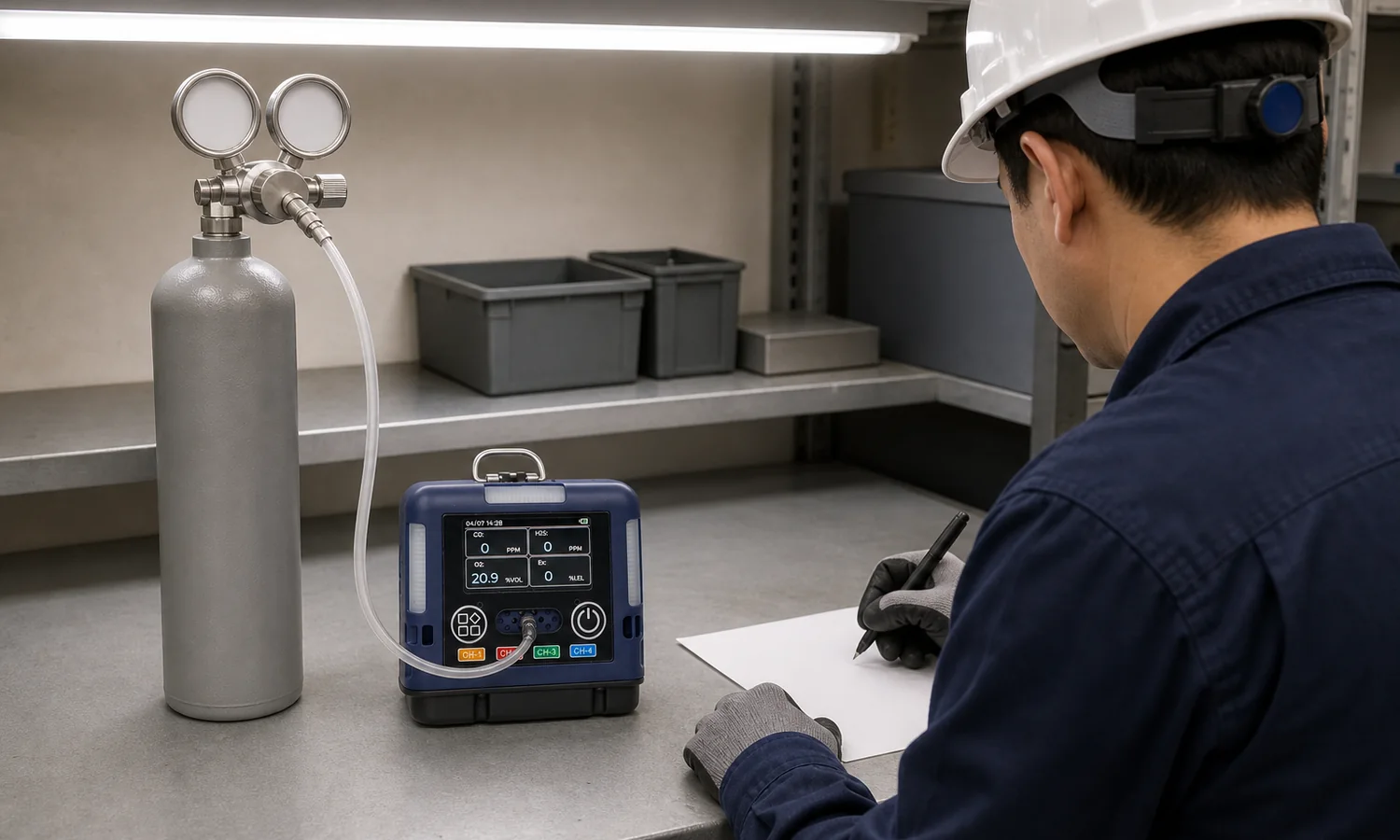
A bump or function test checks that a known test gas produces the expected response and alarms. Calibration checks or adjusts the instrument’s measurement against a known concentration. They answer different questions. Use the procedure and interval applicable to the actual device, gas and site conditions. If the device fails a check, remove it from the task until the fault is investigated and the instrument is returned to service through the applicable process.
Know what the display and alarm mean
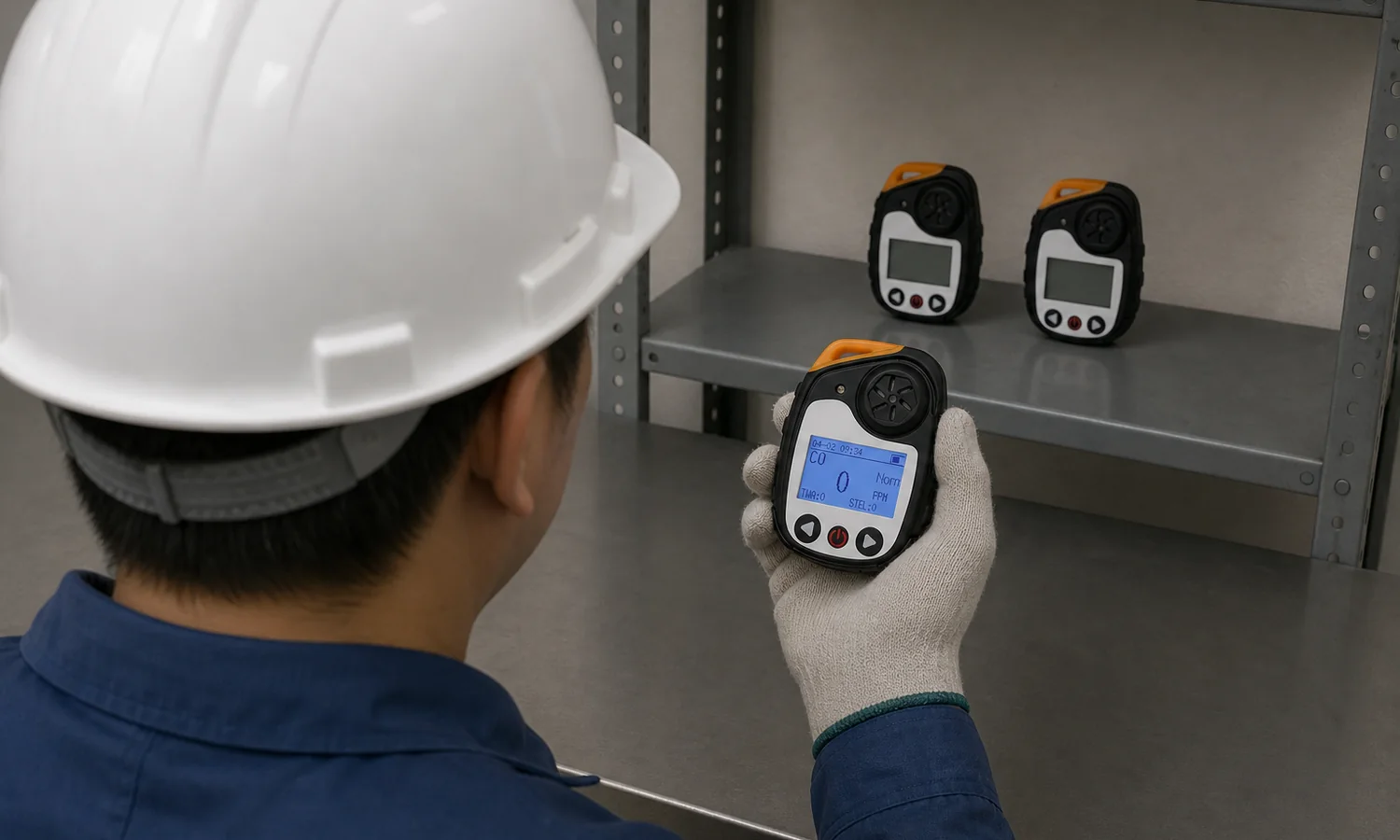
Before the shift, the wearer or tester should know which gas appears on each channel, its unit, and what the configured alarm signals mean. Agree who records the reading or event and who receives the report. Where a pump is used, include a pump fault or blocked-line indication in the check. If the instrument displays zero at a suspected leak, verify the fitted sensor, sample inlet, line condition, wait time and instrument status. Zero is a reading at an instrument under particular conditions; by itself it does not establish that a remote point contains none of the target gas.
- Target gas and range match the task
- Battery and display are usable
- Inlet, probe and line are clear
- Required function check is complete
- Alarms can be noticed at the work position
- Sampling wait and record owner are known
Five specification mistakes that lead to the wrong device
| Shortcut | What it misses | Better question |
|---|---|---|
| Buy by gas-channel count | Which gases and ranges are actually fitted | List each installed sensor, range and unit. |
| Use a diffusion wearable for a remote check | The sample at the distant point never reaches the inlet | Where is the sampling inlet, and what moves the air to the sensor? |
| Use sensor response time as the whole wait time | Tube transport and sample-path effects | What response has been established for this gas and line configuration? |
| Assume listed options are standard | Pump, data link, probe or record-export differences | What is included in the quoted part number and accessory list? |
| Choose from an IP or approval abbreviation alone | The exact ordered version and its supporting documents | Which markings and documents apply to this configuration and place of use? |
These questions are more useful than a generic “best detector” ranking. They turn a model comparison into a specification that can be checked when the device arrives.
Tell us what your detector needs to do
Send us the site and work point, target gases, required ranges and units, whether the task is personal monitoring, remote sampling or leak search, and the intended sample distance. Add the planned probe and tube arrangement if known, number of instruments, shift length, alarm and record needs, and the country or area where the equipment will be used.
Request the fitted sensor combination, sampling version and accessories, alarm and record configuration, operating-time information, and operating and maintenance documents for the exact supplied unit. Check these details against your gas list before placing the order.
Frequently asked questions
Can one portable gas detector monitor any gas?
No. The detector reads the gases supported by its installed sensors, measurement ranges and configuration. A long menu of available sensors for a product family does not mean every unit carries every sensor. Name the target gas and range when requesting a quotation.
When is a single-gas unit enough?
It may fit a task centred on one identified gas when the full gas list for that task has been checked. The decision depends on the atmosphere and work, not on a preference for a smaller instrument. If several gases need simultaneous monitoring, specify their exact combination.
Do I need a pump for personal monitoring?
Not automatically. A diffusion monitor can read the air at its exposed inlet while it is worn. A pump becomes relevant when the sample must be drawn from a point away from the instrument, such as a probe inlet. Specify that remote point and the whole sampling path.
What information is needed for a remote pre-check?
Record the gases and ranges, the positions to be sampled, probe reach, tube material and length, and the instrument’s response requirements. Confirm that the selected pump, line and sensors can work together for the target gases before relying on the configuration.
Is a handheld leak detector the same as a wearable monitor?
They answer different questions. A leak-search instrument is moved along suspected release points; a wearable monitor follows the worker and reads air at its inlet during the job. One model may have several uses, but each use needs a confirmed sampling arrangement.
How do I compare two models with the same number of channels?
Compare the actual gas and range fitted to each channel, sampling method, alarms, records, working time and maintenance documents. “Four channels” alone says little about whether either supplied configuration matches your job.
Why might a pumped detector show zero at a suspected leak?
Check whether the sensor is specified for the gas, whether the probe is at the intended point, and whether the tube is blocked, leaking or unsuitable for the substance. Allow for the complete sampling response and verify the instrument’s status. A zero display cannot settle those questions by itself.
Is a bump test the same as calibration?
No. A bump test checks response and alarm operation with a known test gas. Calibration checks or adjusts measurement against a known concentration. Follow the instructions and schedule for the instrument and gas configuration in use.