
Choose a marine gas detector by the job it must do: test a space before entry, follow a crew member during work, watch a fixed risk point, or locate a suspected leak. The gas list, sample inlet and alarm recipient then determine the instrument configuration.
For a shipboard enclosed-space check, specify an instrument and sampling arrangement that can test the atmosphere before anyone enters. For work inside the space, specify the gases the wearer must continue to monitor. A fixed detector watches its selected point continuously and sends a signal to a compatible alarm system. A leak finder serves a narrower inspection task at an accessible fitting. Begin with a space-and-task schedule, then compare devices against it.
- 1. Identify the space
- 2. Name the gases
- 3. Locate the sample
- 4. Assign the alarm
Map the shipboard task before choosing a detector
A vessel can need several forms of gas detection at once. The relevant question at a cargo-hold hatch is whether the atmosphere can be tested without entry. At a fuel-treatment skid, it is whether an installed point can detect a release in the airflow around the equipment. During an inspection round, the concern moves with the crew member. Those are different sampling locations, even if the gas names overlap.
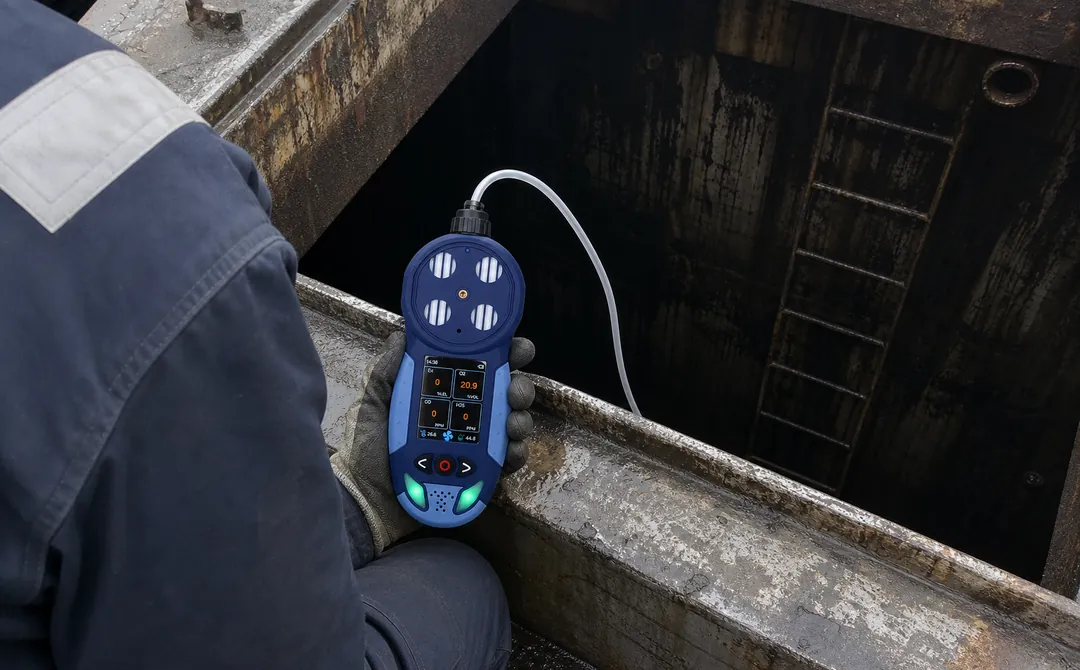
Entry into a hold, tank or other enclosed space
Start with the ship’s list of enclosed spaces and the current contents or previous service of each space. Cargo holds, ballast tanks, bilges, pump rooms and chain lockers can all present atmospheric hazards. Connected or adjacent spaces may need attention as well. The IMO’s 2025 revised recommendations identify these spaces and call for testing before entry and at intervals while work continues. They also describe sampling at different levels and areas where needed to obtain a representative reading. A single reading at the hatch cannot describe a large space with recesses, structural obstructions or a different atmosphere at its lower level.
Write the proposed sampling positions on the entry plan: at the opening, farther inside where the line can reach, and at different levels when the space geometry calls for it. The instrument must receive air from those positions. Probe reach, line material, sample transit time and access for checking the inlet all belong in the equipment specification.
Rounds and maintenance
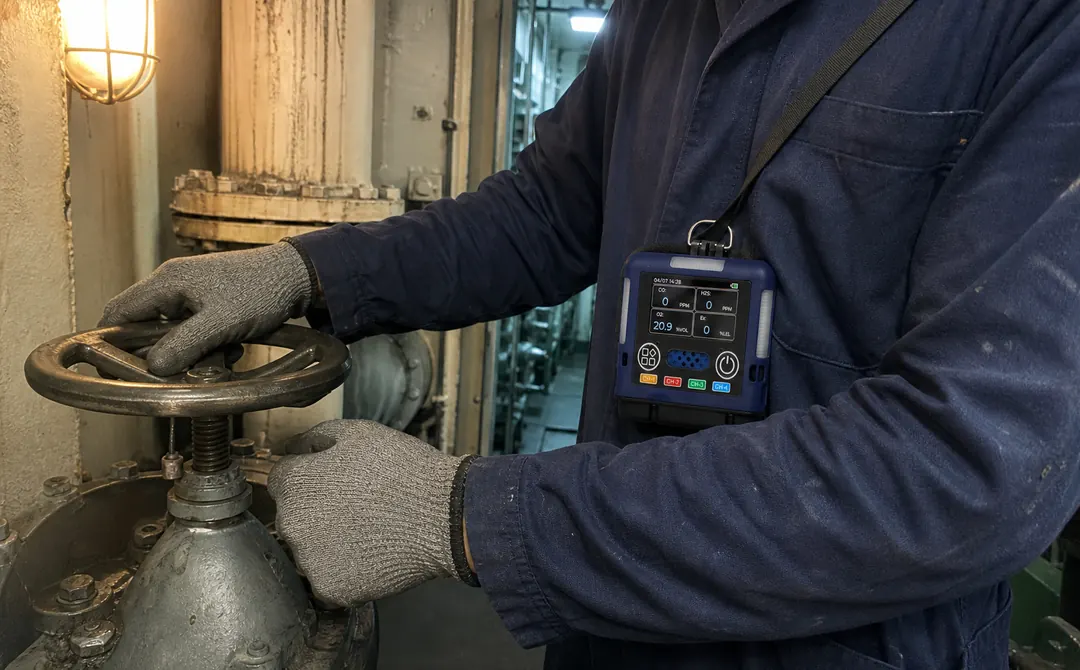
A portable monitor travels with the worker. Its inlet needs to remain exposed to the surrounding air, and its alarms need to be noticed over the noise of machinery and ventilation. Specify the route, task duration, gas channels, local alarm modes and how a reading or event will be recorded. A fixed point in the engine room does not give a reading at every place a fitter may open a cabinet, inspect a valve or enter a compartment.
Continuous monitoring at a defined point
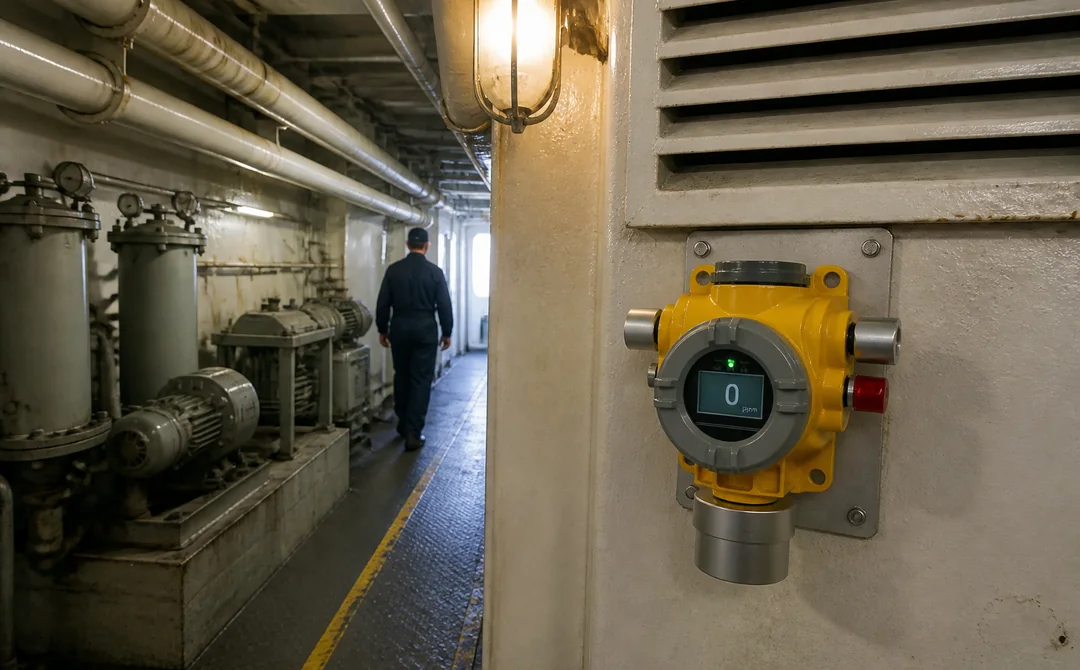
Fixed detection is useful where a named source or area requires continuous observation. Mark the equipment, likely release location, ventilation supply and exhaust, nearby obstructions, and the place where the crew will receive an alarm. Gas density matters, but fan direction and the vessel’s physical layout can change where a release travels. A drawing that shows detector height without showing airflow is an incomplete location decision.
| Shipboard situation | Question to answer | Likely instrument form | Alarm recipient |
|---|---|---|---|
| Cargo hold or ballast tank before entry | What is present at the positions the crew cannot approach yet? | Portable instrument with a suitable remote sampling arrangement | Person conducting the test and entry team |
| Inspection or work inside a space | What is the atmosphere around the wearer as conditions change? | Personal monitor with the specified fitted gases | Wearer and the ship’s agreed reporting route |
| Fuel equipment or pump group | Does the selected point show a changing gas concentration? | Fixed detector and compatible receiving system | Engine control room or designated watch |
| Accessible pipe joint under investigation | Where is the suspected release originating? | Instrument configured for close-range leak search | Technician conducting the inspection |
Specify the gases, units and measurement conditions
Start with the enclosed-space testing requirement
SOLAS regulation XI-1/7 requires ships to carry an appropriate portable atmosphere-testing instrument or instruments capable, at a minimum, of measuring oxygen, flammable gases or vapours, hydrogen sulphide and carbon monoxide before entry into enclosed spaces. It also calls for suitable means of calibration. This describes the ship’s minimum portable testing capability; it does not say that every ordered four-channel instrument measures every hazard in every cargo space. Read the SOLAS amendment in the IMO resolution alongside the ship’s actual gas list.
The IMO’s 2025 revised enclosed-space recommendations go further in their testing guidance: the equipment should suit the cargo carried, including conditions with depleted oxygen; the guidance discusses carbon dioxide testing, representative sampling and personal monitoring during entry. Keep that recommendation distinct from the four categories named in SOLAS XI-1/7. Cargo declarations, safety data and the ship’s entry procedure may identify further substances to measure.
Write ranges and units beside every gas
“Combustible gas” is still too broad for a purchase order. Specify the expected substance, whether the question is a low-level leak or flammability, and the required range. Percent LEL expresses a fraction of the lower explosive limit for a specified gas and calibration basis; percent by volume expresses a volume fraction. Toxic-gas channels commonly use ppm. Oxygen is usually displayed as percent by volume. A number without its gas and unit is easy to misread in a record or alarm schedule.
For each gas, ask which sensor is actually fitted, what concentration it can read, what calibration gas and method apply, and whether the sampling line can carry that gas without distorting the reading. A catalogue list of optional gases describes a product family, not one instrument’s installed sensor set. Where an atmosphere may be oxygen depleted or inerted, confirm that the selected combustible-gas measurement principle works under that condition. Do not infer this from a normal-air specification.
| Measurement | What to specify | Question for the supplier |
|---|---|---|
| Oxygen | Range and %VOL display | Is the fitted channel suitable for the atmosphere and entry procedure? |
| Flammable gas or vapour | Named target gas, %LEL or %VOL range, calibration basis | How will this sensor behave in the expected oxygen level? |
| CO and H₂S | Each required ppm range | Are both channels fitted in the quoted configuration? |
| Cargo- or fuel-specific gas, including CO₂ when identified | Named gas, expected range and relevant work stage | Is a compatible sensor and sampling path available? |
Choose how the atmosphere reaches the sensor
Pumped sampling before approach
A pump and probe let the tester place the inlet away from the instrument. That is the useful arrangement when the atmosphere must be checked inside a hold or tank before a person approaches the sampling position. The probe’s location is the measurement point; the operator’s hand is not. State the longest intended reach and the positions to be tested, then confirm the tube material, filter and pump arrangement for each target gas.
Do not treat the sensor’s response time as the total wait. Air must travel through the probe and line before it reaches the sensing element. Line length, internal volume, pump flow, gas adsorption and any blockage can affect the time or quality of the reading. The work instruction should use the response established for the full sampling configuration. A pump-fault indication is useful only if the crew know how to recognize it and what to check.
Diffusion monitoring during work
A diffusion instrument reads air at its own inlet. Worn on the person, it follows the worker and can warn when the local atmosphere changes. It cannot read air at the bottom of a tank while it remains at the hatch. Before issue, check the fitted gases, display units, battery, inlet condition and local alarms. The alarm needs to be audible, visible or otherwise perceptible where the work takes place, not merely on a bench in a quiet office.
Fixed points and close-range leak tracing
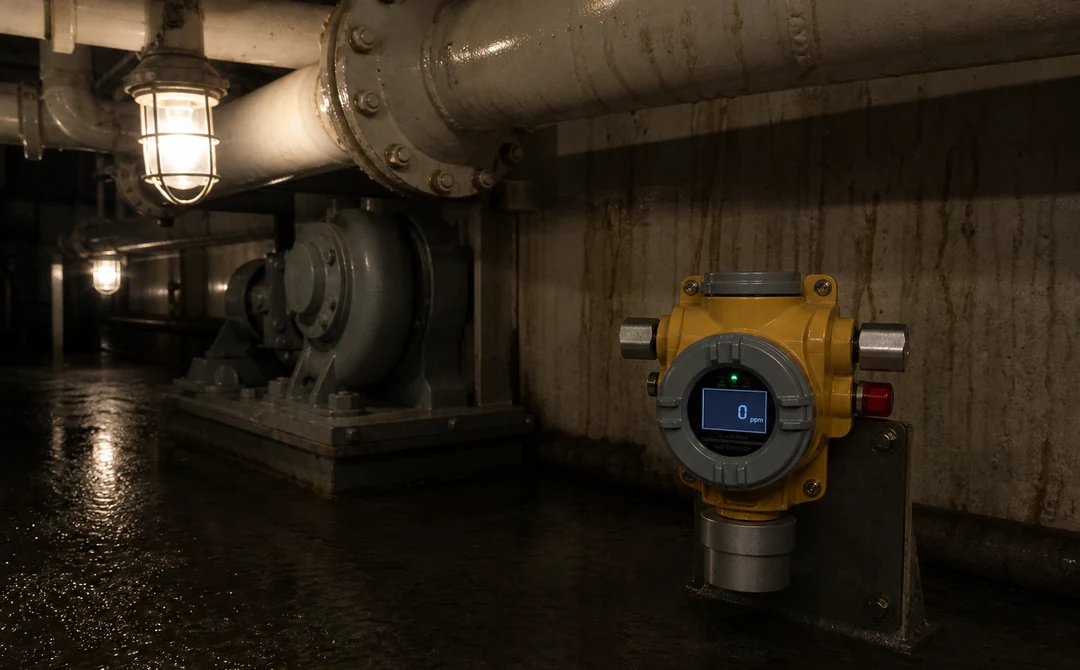
A fixed detector continuously measures at its installed location. Its location should follow the release mechanism and airflow, with enough access for inspection and calibration. Specify output and power together with the receiving controller; a matching protocol name alone does not establish that two particular ordered versions are wired and configured as a working system.
Leak tracing is narrower. A technician moves an instrument near an accessible fitting to narrow down a suspected source after the area has been assessed. The target gas, range and actual sampling mode must match that job. A close-range leak finder does not perform a representative pre-entry atmosphere test merely because it displays a concentration.
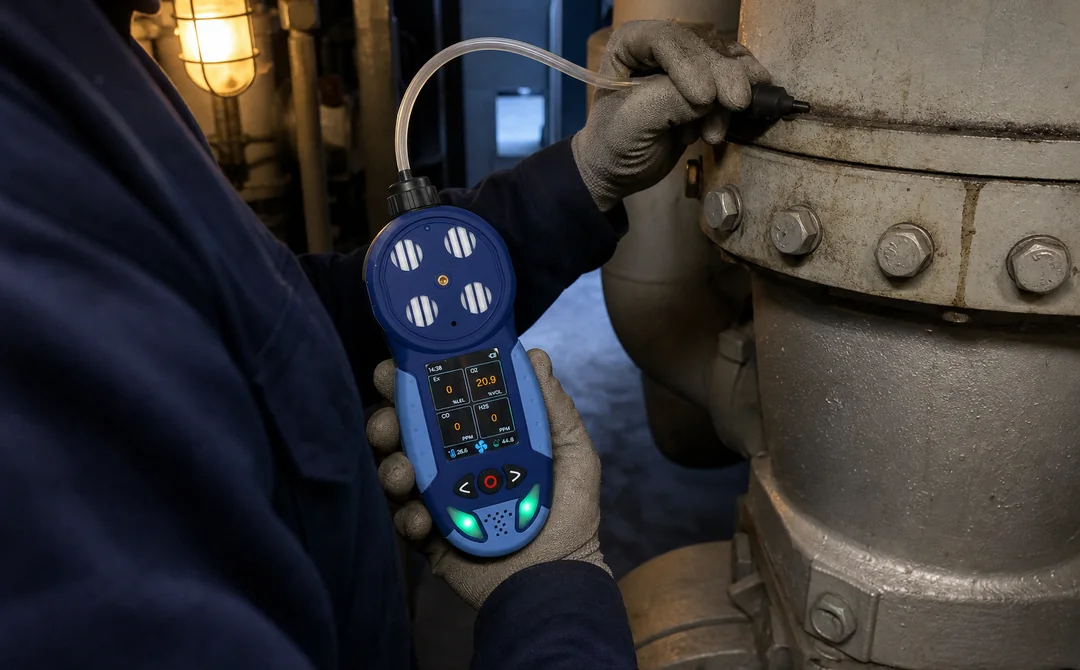
| Method | Where the sample comes from | Best-fitting question | Configuration to confirm |
|---|---|---|---|
| Pumped portable | Remote probe or tube inlet | What is the atmosphere at a point ahead of the operator? | Target gases, line, flow, response and blockage indication |
| Diffusion portable | Air immediately around the instrument | What is changing around the wearer? | Fitted channels, alarms, battery and wearing position |
| Fixed detector | Selected installed point | Is a defined area showing a release? | Sensor, location, power, output and controller |
| Leak-search instrument | Accessible point under investigation | Which fitting may be releasing the target gas? | Gas, range and confirmed sampling mode |
Otywell equipment for four shipboard roles
These models answer different questions. The ordered sensor combination, sampling version, output and documentation should be matched to the ship’s equipment schedule.
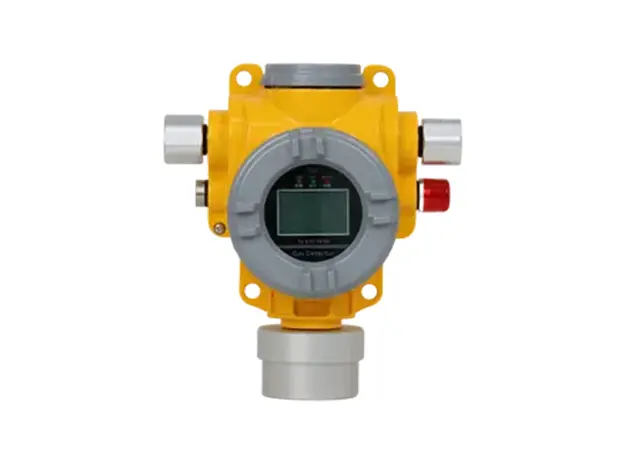 Fixed point
TCB2-F Point Type Four Gas Detector
Configurable one-to-four-gas detection at a selected fixed point. Confirm the fitted gases, range and signal output.
View TCB2-F product details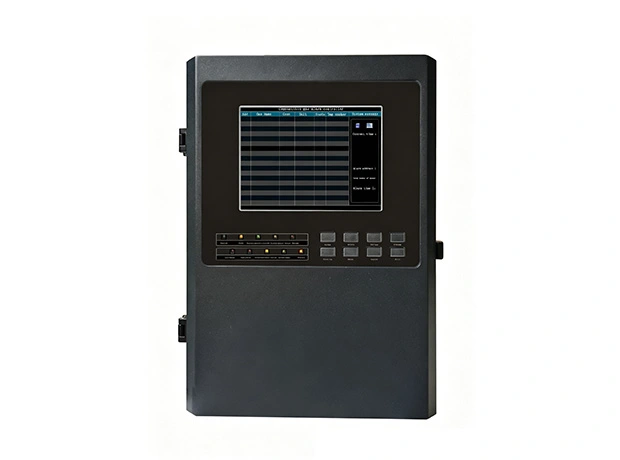 Central alarm
GDB9 Intelligent Gas Alarm Controller
Receives compatible detector signals for central display, alarm handling and event records.
View GDB9 product details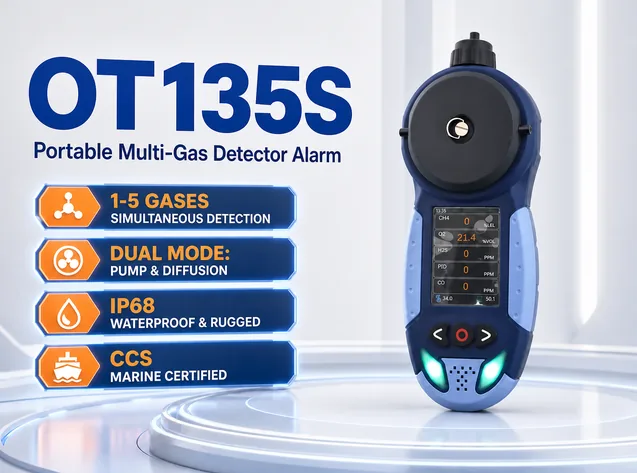 Remote sampling
OT135S Portable Gas Detection Alarm
Specify the pump-suction version for remote checks, or the diffusion version for local monitoring; select one to four gases.
View OT135S product details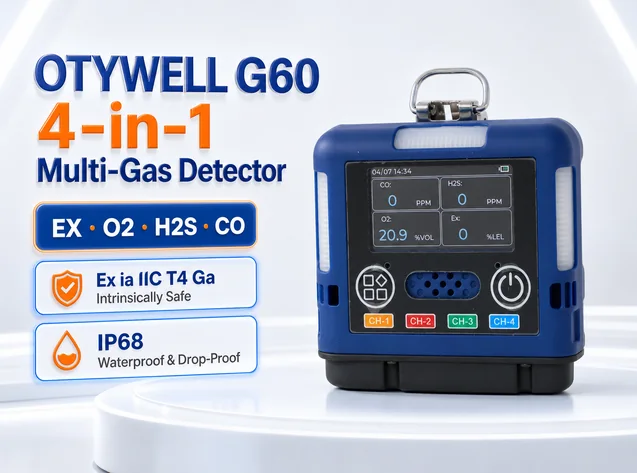 Personal monitoring
G60 4 in 1 Multi-Gas Detector
Diffusion-type portable monitoring with configurable gas sensors and local sound, light and vibration alarms.
View G60 product detailsDesign an alarm path that a crew can use
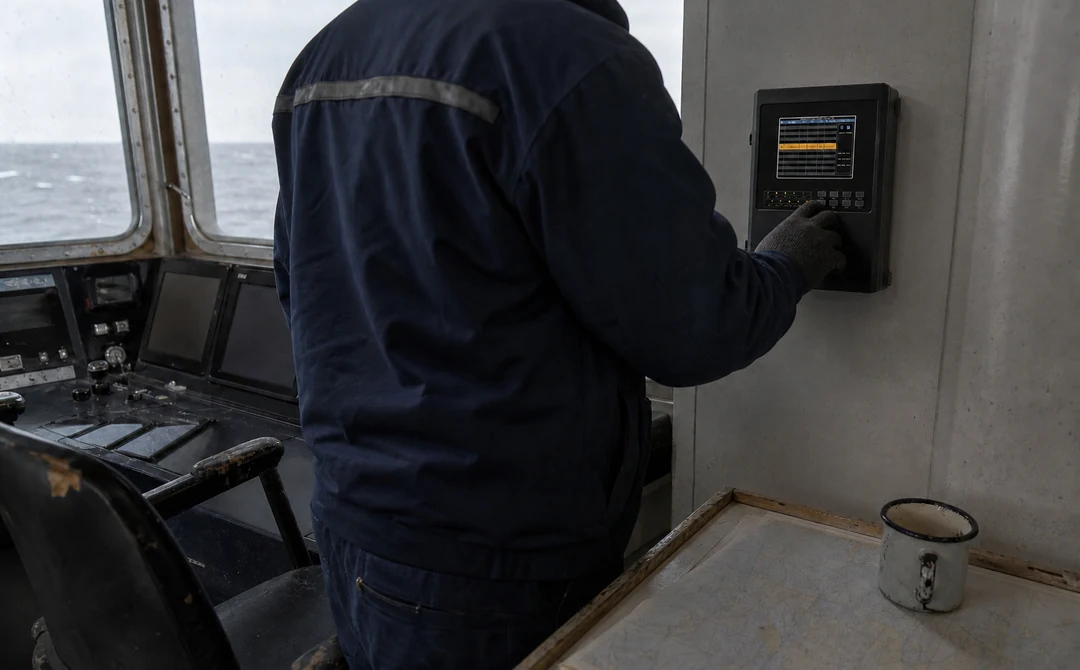
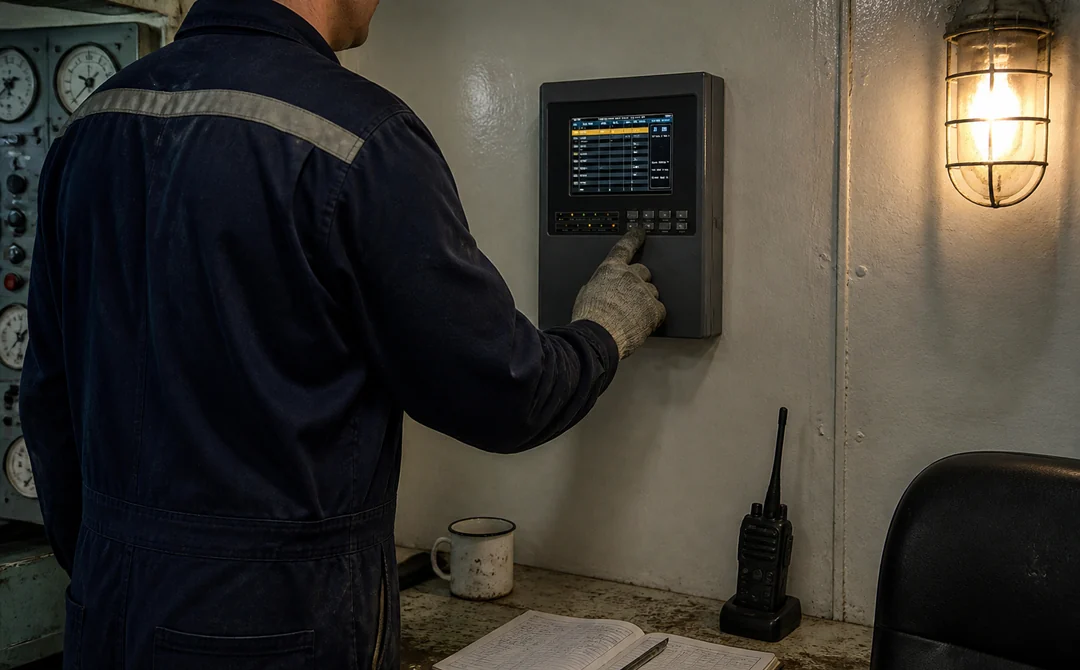
A reading becomes useful when the right person can identify the affected point and act on it. For a fixed installation, give each detector a point name that matches the vessel drawing and controller channel. Record the gas, range, alarm setpoints, signal type and receiving location on the same schedule. At the controller, a gas alarm, a disconnected sensor and a power fault must be distinguishable. Test those states during commissioning rather than assuming that one illuminated panel proves the complete path works.
The GDB9 can receive specified 4–20 mA or RS485 channels, display readings and manage configured alarms. The TCB2-F can be ordered with selected gas channels and output. The final wiring design still needs the exact channel map, power arrangement and defined alarm actions. Where the engine room also needs flame coverage or coordinated actions, the existing ship engine room monitoring solution shows that application in more detail.
Portable use has a different reporting path. Agree who conducts a pre-entry test, who records the results, who wears the monitor during work and how an alarm is communicated to the attendant or watch. Record the instrument identifier and fitted gases with the reading. For a pumped unit, include pump status and the sampling position; otherwise a later reader cannot tell what part of the space the number represents.
Keep checks and records tied to the actual configuration
A function or bump check establishes that the instrument responds to a test gas and produces its expected indications. Calibration checks or adjusts measurement against a known concentration. Inspect the inlet, line and filter as part of the configuration that will be used. Document faults, remedial work and the instrument’s return to service. The applicable instructions and ship procedure determine the timing; a generic interval printed in an article would not describe every device or operating condition.
Send a specification that can be quoted and commissioned
A useful enquiry describes the ship and the measurement job in the same document. If a supplier receives only “marine four-gas detector,” they cannot know whether the request is for an entry test, a wearable unit, a fixed point or several of these. The following fields make the proposed configuration reviewable.
- Vessel type, flag, class and destination approval requirements
- Space names, drawings, work stages and access points
- Cargo, fuel, residues and relevant safety data
- Target gases, ranges, display units and calibration basis
- Remote sampling positions, probe reach and tube arrangement
- Fixed detector positions, ventilation and maintenance access
- Power, output, controller channels and alarm recipients
- Operating environment, certificates and exact supplied version
- Accessories, test gas, replacement parts and records required
At delivery, compare each supplied device with that brief. Confirm the installed sensor labels and ranges, the pump or diffusion version, probe and line parts, and the certificate or approval documents for that exact version. At commissioning, challenge each fixed point and receiving channel, observe the intended local and central alarms, and test fault and power-loss indications. For portable instruments, verify the complete sample path and that the crew can identify each channel and its alarm meaning.
If the ship’s target gas, low-oxygen condition, required approval or remote sampling distance is still unknown, keep that item open in the equipment schedule. Those facts determine the ordered configuration; a model name alone cannot settle them.
Prepare a marine gas detection enquiry
Send the vessel type, space list, cargo or fuel information, target gases and ranges, sampling points, alarm recipients and approval requirements. Add drawings for fixed locations and the longest intended probe reach for remote tests. We can then identify the portable and fixed configurations that match each task.
Frequently asked questions
What gases should be tested before entering an enclosed space on a ship?
SOLAS XI-1/7 names oxygen, flammable gases or vapours, hydrogen sulphide and carbon monoxide as the minimum capabilities for the ship’s portable testing instrument or instruments. The actual space may call for other gases as well. The 2025 IMO recommendations discuss cargo-specific testing and carbon dioxide, so check the ship’s cargo information and entry plan when specifying sensors.
Can one four-gas detector cover every shipboard task?
No. The installed channels must match the gases that can be present, and the sampling arrangement must reach the measurement point. A four-channel wearable cannot remotely sample a tank without the appropriate pump and line. A fixed detector monitors its installed point rather than every place a crew member may work.
Why use pumped sampling before entering a tank or cargo hold?
It places the sample inlet inside the space while the tester remains at a different position. The arrangement can reach selected levels or areas through a suitable probe or hose. Allow for the complete line and instrument response, and check that the sampling parts suit the target gases.
When does a ship need fixed gas detectors?
Fixed detection fits a defined area that needs continuous measurement and a route to a watchkeeper or control room. The proposed point depends on the source, ventilation and physical layout. It complements portable checks when the crew also need readings before entry or along a moving work route.
Can a diffusion detector replace a pumped pre-entry check?
A diffusion detector reads air at its own inlet. If it remains at the hatch, it does not read air at a distant point inside the space. Pre-entry sampling from that point needs an arrangement that brings the air to the sensor.
Does an IP rating establish marine approval?
No. An enclosure rating describes a defined protection characteristic. The required maritime, hazardous-area or other approval documents must be checked against the actual ordered device, its marking and the vessel’s place of use.
What information should a buyer send for a marine gas detector quotation?
Provide the vessel and destination requirements, spaces and tasks, cargo or fuel, target gases and ranges, remote sampling distance, fixed-point drawings, power and signal needs, alarm recipients and required approval documents. Identify which measurements are needed before entry and which must continue during work.