Laboratory Gas Cylinder and Work Area Monitoring Solution
Laboratory gas hazards do not begin and end at the cylinder. A release can occur at the valve, regulator, manifold, flexible connection, distribution line or experimental apparatus. Cryogenic liquids and inert gases introduce another risk by displacing oxygen without producing a useful warning smell.
Otywell combines fixed detection, central alarm control, pump-sampled gas analysis and personal monitoring in one laboratory gas detection solution. The arrangement covers normal operation as well as cylinder changes, maintenance and alarm investigation.
- Continuous monitoring of selected laboratory gas hazards
- Coverage for cylinder rooms, gas cabinets and occupied work areas
- Central alarm display and configurable output signals
- Pumped analysis before opening or approaching an affected enclosure
- Personal monitoring during handling, inspection and maintenance
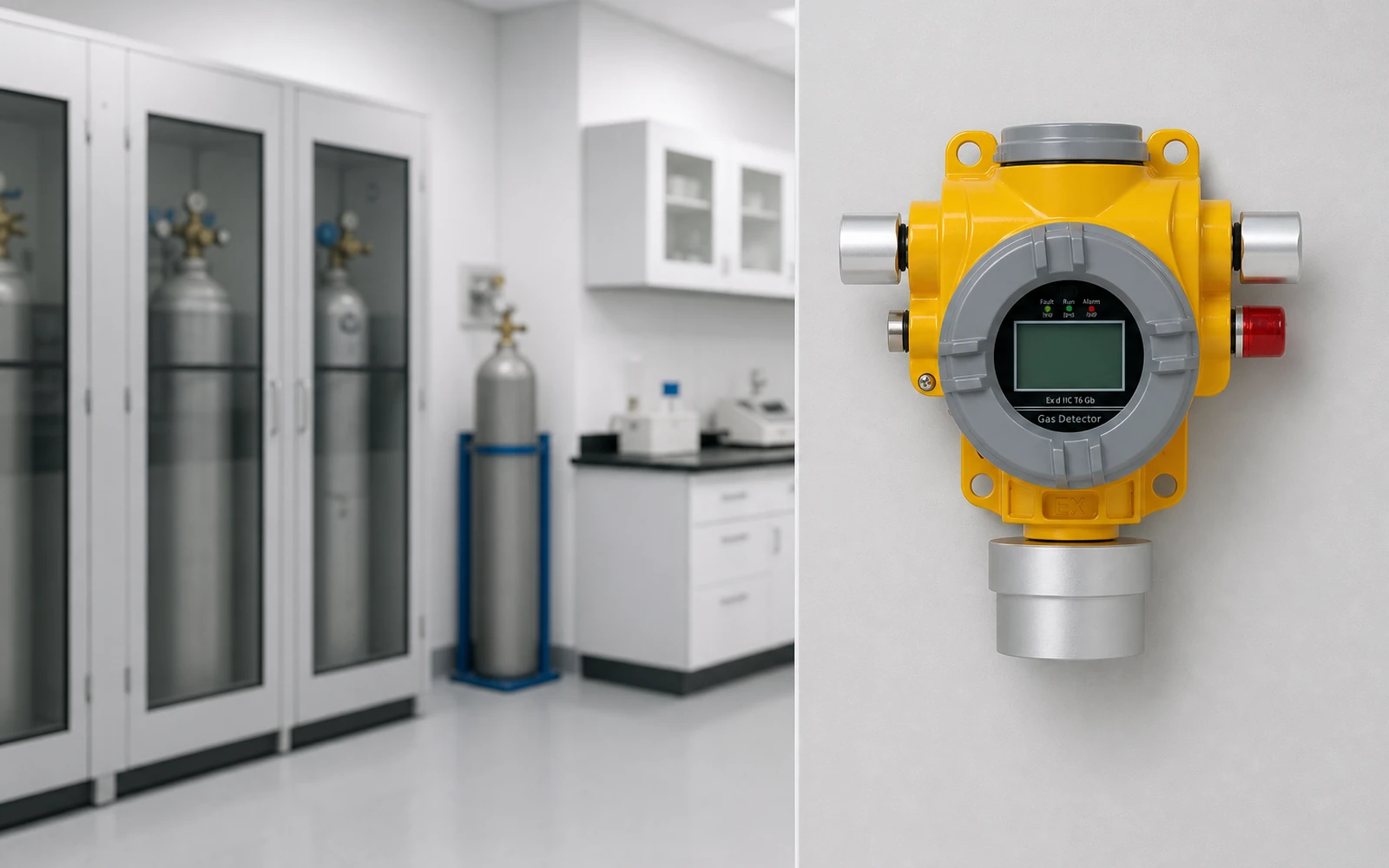
Continuous gas monitoring around laboratory cylinder storage and supply equipment.
The monitoring problem
The gas inventory determines the monitoring system
Laboratories use gases for analysis, synthesis, calibration, controlled atmospheres, combustion, refrigeration and sample preparation. The safety problem changes with the contents of each cylinder and the way the gas is delivered.
Hydrogen, methane and other flammable gases can form an ignitable mixture after a leak. Ammonia, hydrogen sulfide, sulfur dioxide and chlorine can create a toxic exposure at much lower concentrations. Nitrogen, argon and helium are not flammable, but a substantial release can reduce the oxygen available in an enclosed room. Carbon dioxide can displace oxygen and also presents a direct exposure hazard of its own.
Oxygen introduces the opposite problem. A leak from an oxygen supply can create an enriched atmosphere in which materials ignite more readily and burn more intensely.
A standard four-gas configuration is not a universal laboratory package. An instrument fitted for combustible gas, oxygen, carbon monoxide and hydrogen sulfide will not automatically detect ammonia, chlorine, carbon dioxide or hydrogen. Each installed sensor must match a gas that can actually be released in that zone.
Monitoring zones
Follow the gas from storage to its point of use
Dividing the facility by release source and occupied area makes the design easier to review. It shows where a leak may begin, how gas could travel and which people or experiments may be affected.
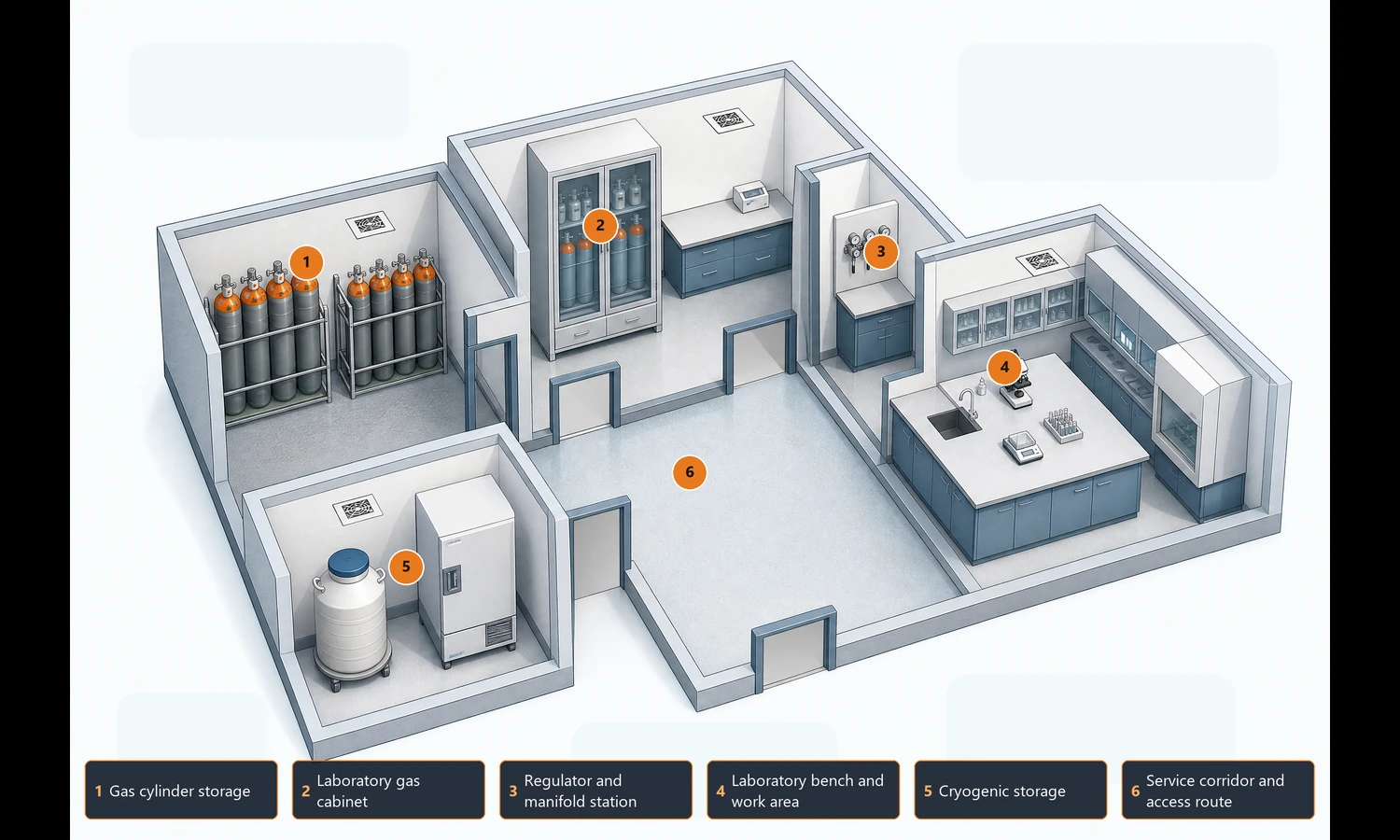
Suggested monitoring zones across cylinder storage, distribution and laboratory use points.
| Laboratory zone | Possible hazard | Monitoring objective | Detection layer |
| Gas cylinder storage room | Toxic or flammable release, oxygen deficiency or oxygen enrichment | Warn personnel before entry or continued occupancy becomes unsafe | Fixed detector, external alarm and central controller |
| Ventilated gas cabinet | Leakage from a cylinder valve, regulator, manifold or connection | Detect gas within the cabinet or exhaust path before it spreads | Gas-specific fixed detection and an approved shutoff signal |
| Distribution manifold | Leakage at regulators, valves, fittings and changeover assemblies | Monitor the supply point and nearby occupied area | Fixed detector with local and central alarm indication |
| Laboratory work area | Release from tubing, equipment or an experimental process | Monitor the occupied zone and selected equipment locations | Fixed area detection supported by personal monitoring |
| Cryogenic storage or freezer room | Oxygen displacement by nitrogen, argon, helium or carbon dioxide | Warn personnel outside and inside the affected room | Fixed oxygen monitoring and direct CO2 detection where required |
| Maintenance or alarm investigation | Unknown or changing atmosphere near the suspected release | Sample remotely and compare readings before closer approach | OT800 pumped analysis and G40S personal monitoring |
System architecture
Four layers cover routine operation and non-routine work
Fixed detection
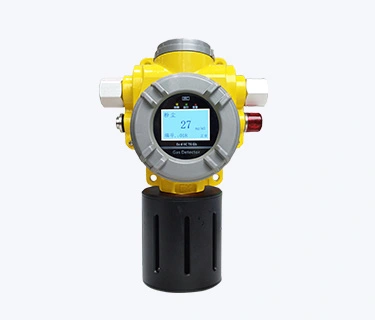
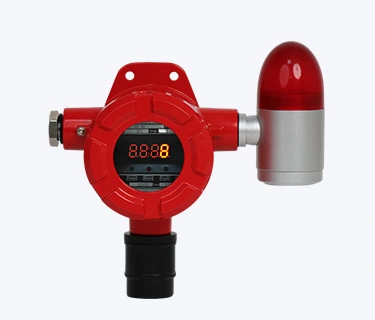
TCB2-F detectors continuously monitor identified release points and occupied areas for the gases selected during the risk assessment.
Alarm control
The GDB9 receives field signals, identifies the affected point and provides configured outputs to warning and control equipment.
Investigative sampling
The OT800 draws samples from cabinets, rooms and equipment. Its colour touchscreen and concentration curves support comparison during an investigation.
Personal monitoring
The G40S stays near the worker’s breathing zone during cylinder changes, inspections and maintenance.
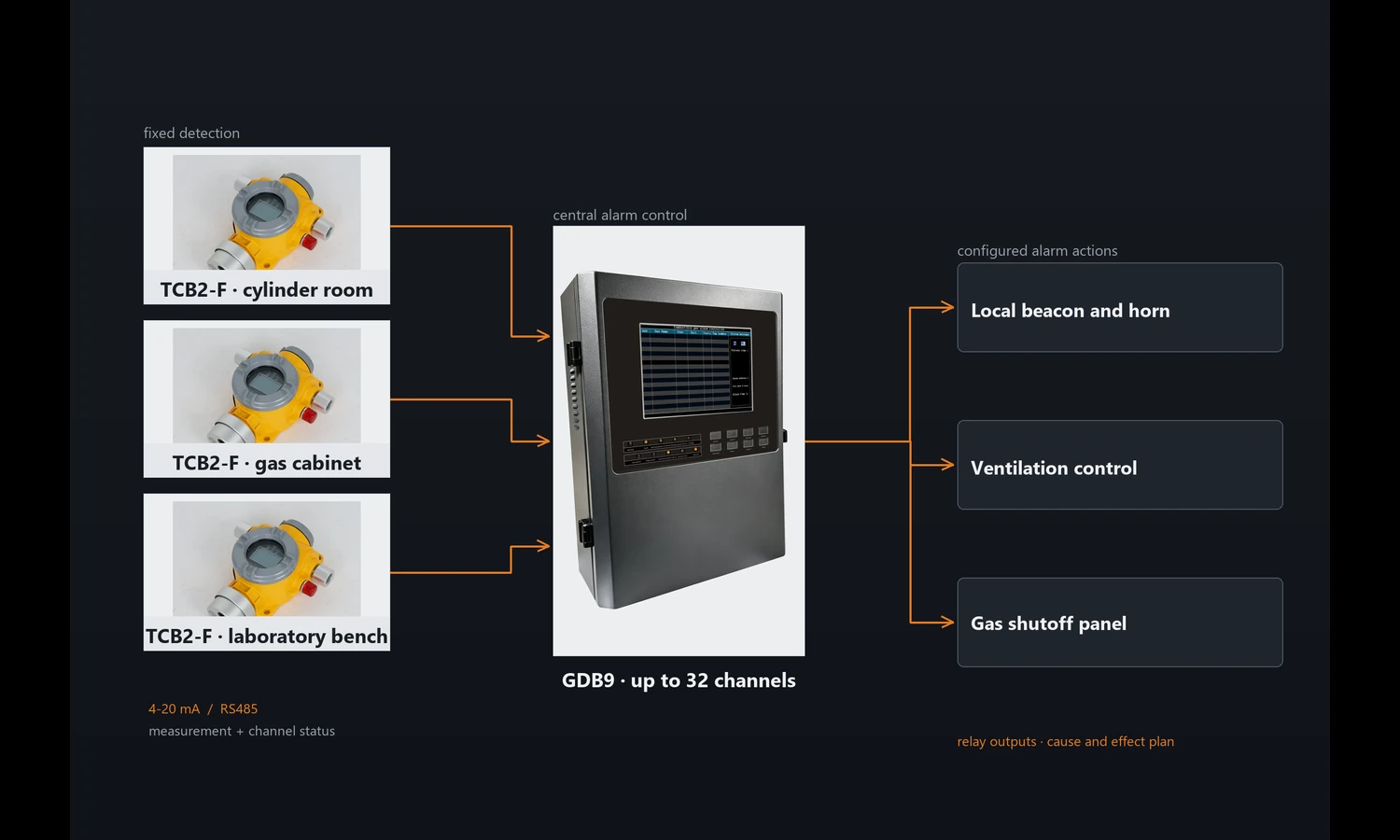
Conceptual signal path from field detection to alarm, ventilation and approved isolation functions.
These layers are not interchangeable. A fixed detector watches one installed position. The OT800 analyses a sample drawn from a chosen location. The G40S follows the worker. The controller shows system status and sends the responses defined by the facility.
Continuous detection
Configure the TCB2-F for each monitoring zone
The TCB2-F Point Type Four Gas Detector can monitor one to four gases in a configured unit. Available sensor principles include catalytic, electrochemical and infrared detection, subject to the selected gas and measuring range.
Laboratory configurations may include:
- Hydrogen or fuel-gas detection around compatible supply equipment
- Oxygen monitoring in inert-gas and cryogenic storage areas
- Direct carbon dioxide monitoring where CO2 is stored or used
- Toxic gas monitoring around compatible gas cabinets and supply points
- Combined monitoring where the selected sensors can operate together
The detector has an integrated audible and visual alarm. It supports 4-20 mA and RS485 signal transmission. LoRa, NB-IoT and 4G communication are configured options. Its stainless steel housing and IP66 protection suit demanding installations, but the final location must remain within the environmental and certification limits of the ordered version.
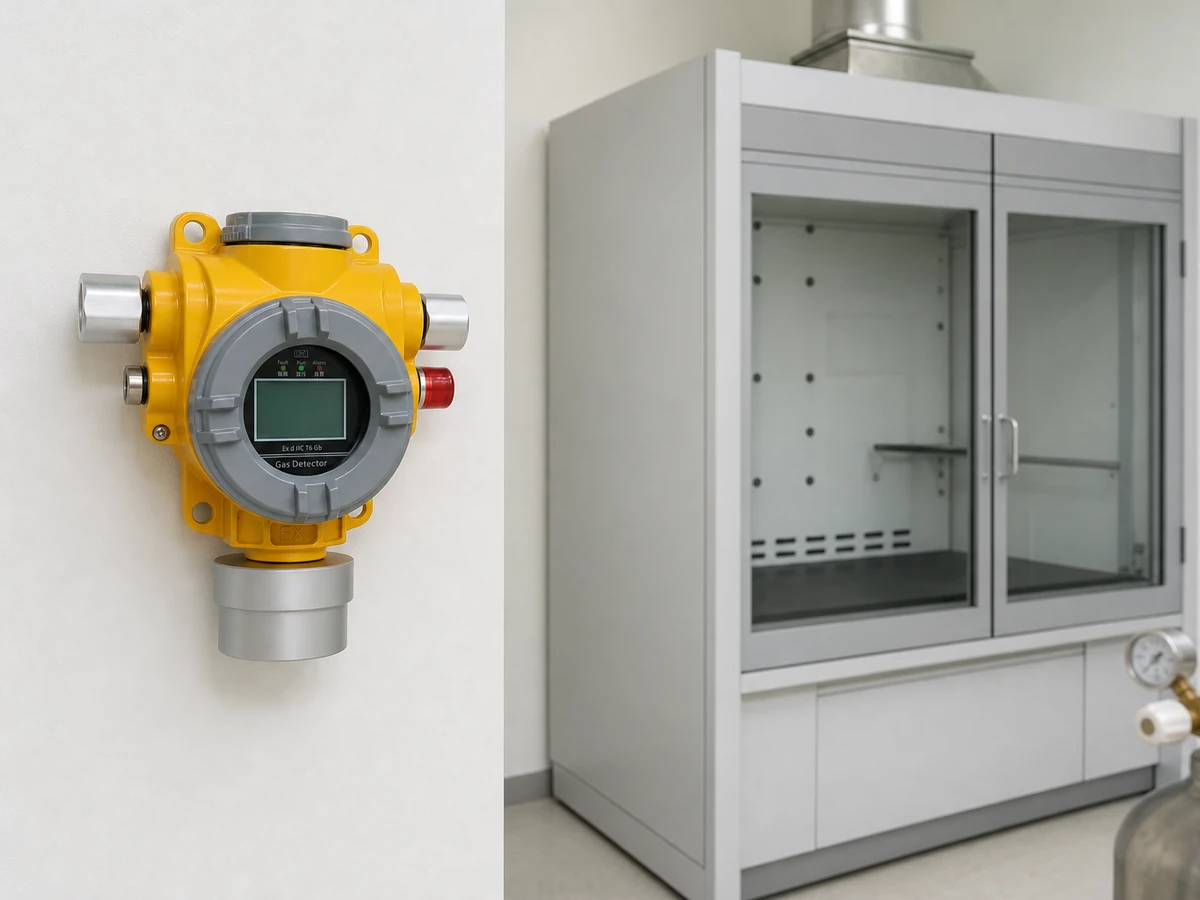
Example placement near a ventilated gas cabinet. Final position depends on the release and airflow assessment.
Gas and sensor selection
Match the sensor to the gas, range and release condition
| Gas or group | Typical source | Main concern | Selection note |
| Hydrogen | Cylinders, generators, fuel cells and research apparatus | Flammable atmosphere | Use a hydrogen-compatible sensor and assess high-level accumulation paths, ventilation and ignition sources. |
| Methane or fuel gas | Burners, cylinders, utility supply and test equipment | Flammable atmosphere | Specify the target gas and calibration basis for the combustible sensor. |
| Nitrogen, argon or helium | Cylinders, dewars, glove boxes and analytical equipment | Oxygen displacement | Monitor oxygen in representative occupied areas. The oxygen sensor does not measure the inert gas directly. |
| Carbon dioxide | Cylinders, incubators, chambers and dry ice | Direct exposure and oxygen displacement | Direct CO2 detection may be required because an oxygen alarm alone may not provide the required warning. |
| Oxygen | Oxygen cylinders and enriched-atmosphere experiments | Oxygen enrichment or deficiency | Configure low and high oxygen alarms when the assessment identifies both conditions. |
| Ammonia, H2S, SO2 or chlorine | Compressed gas cylinders and experimental processes | Toxic exposure | Select a gas-specific sensor, suitable range and compatible installation and sampling materials. |
A multi-gas detector is not automatically suitable for every combination
Sensor compatibility, expected background gas, cross sensitivity, temperature, humidity and required response time all affect the configuration. Reactive or adsorptive gases may also need specialised sampling materials.
Detector placement
Put the sensor in the path of a credible release
Mounting every detector at the same height is a poor substitute for a site assessment. Gas density matters, but ventilation, release pressure, gas temperature, cabinet extraction and room geometry can change where a gas travels.
- Start with cylinder valves, regulators, manifolds and frequently disconnected fittings.
- Review cabinet exhaust direction and the location of room supply and return grilles.
- Check service penetrations through walls, ceilings and utility ducts.
- Account for benches, partitions and equipment that can restrict dispersion.
- Consider where personnel stand, enter the room or change cylinders.
- Leave safe access for gas testing, calibration and sensor replacement.
A detector inside an extracted gas cabinet may identify a leak close to the cylinder. A separate room detector may still be needed if gas can escape from downstream tubing or experimental equipment. Storage, distribution and use are separate parts of the assessment.
Oxygen monitors should represent the atmosphere in the occupied zone. A sensor placed directly inside an exhaust stream may not represent the air elsewhere in the room.
Alarm and control
Use the GDB9 to identify the affected zone
The GDB9 Intelligent Gas Alarm Controller accepts multiple 4-20 mA or RS485 detector signals. It can manage up to 32 channels, subject to the selected wiring and system configuration.
Each channel can be assigned to a detector location, gas and equipment tag. When a field detector reaches a configured condition, the controller displays the affected point and activates its audible and visual alarm. Alarm and fault records remain available for review.
Its six passive relay outputs can provide approved signals to:
- Warning beacons and sounders
- Mechanical exhaust or emergency ventilation
- Gas supply shutoff equipment
- A building management system, PLC or control room
- Access-control or remote notification equipment
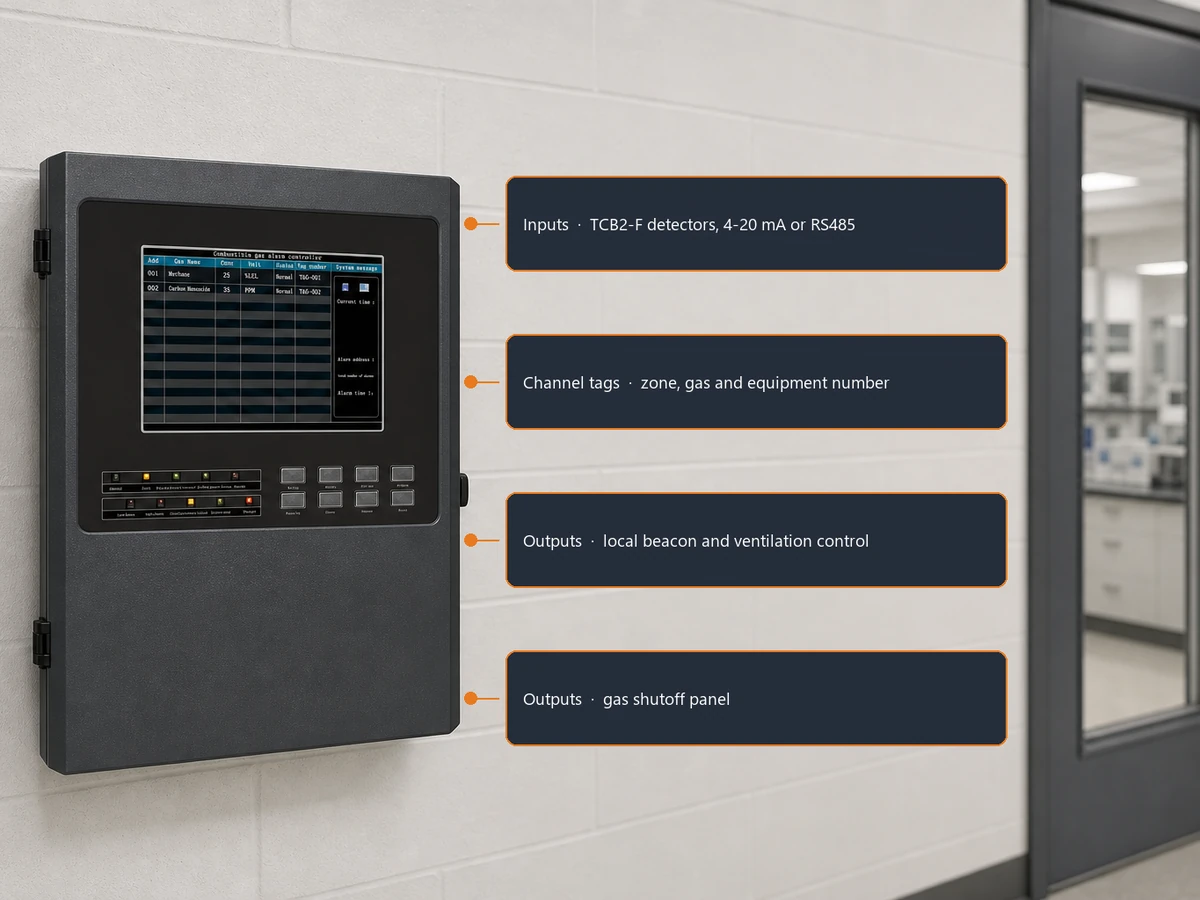
The controller identifies the alarm point and sends the outputs defined by the facility.
Relay contacts do not define the cause-and-effect strategy
The laboratory designer must decide what happens at each alarm level. Automatic valve closure or ventilation changes should be reviewed against the gas supply, experiments, fume hoods, building controls and emergency procedure. Detector faults and communication loss also need defined responses.
Investigative gas analysis
Use the OT800 to examine an alarm before moving closer
A fixed alarm identifies the affected zone, but it may not reveal which cylinder, fitting or piece of equipment is responsible. The OT800 Portable Multi-Gas Analyzer supports the investigation by drawing a sample from a selected location through its built-in pump.
With compatible tubing and a suitable probe, the operator can collect a sample from inside a gas cabinet, through a room sampling port or around enclosed equipment while remaining outside the immediate area. The colour touchscreen displays current concentrations and real-time curves, allowing technicians to compare locations and observe whether readings change after isolation or ventilation.
Typical laboratory tasks include:
- Sampling a ventilated gas cabinet before opening it
- Checking a cylinder room from an external sampling point
- Comparing readings around regulators, valves and manifolds
- Investigating distribution lines and service penetrations
- Checking enclosed equipment before maintenance
- Reviewing concentration changes after ventilation or isolation
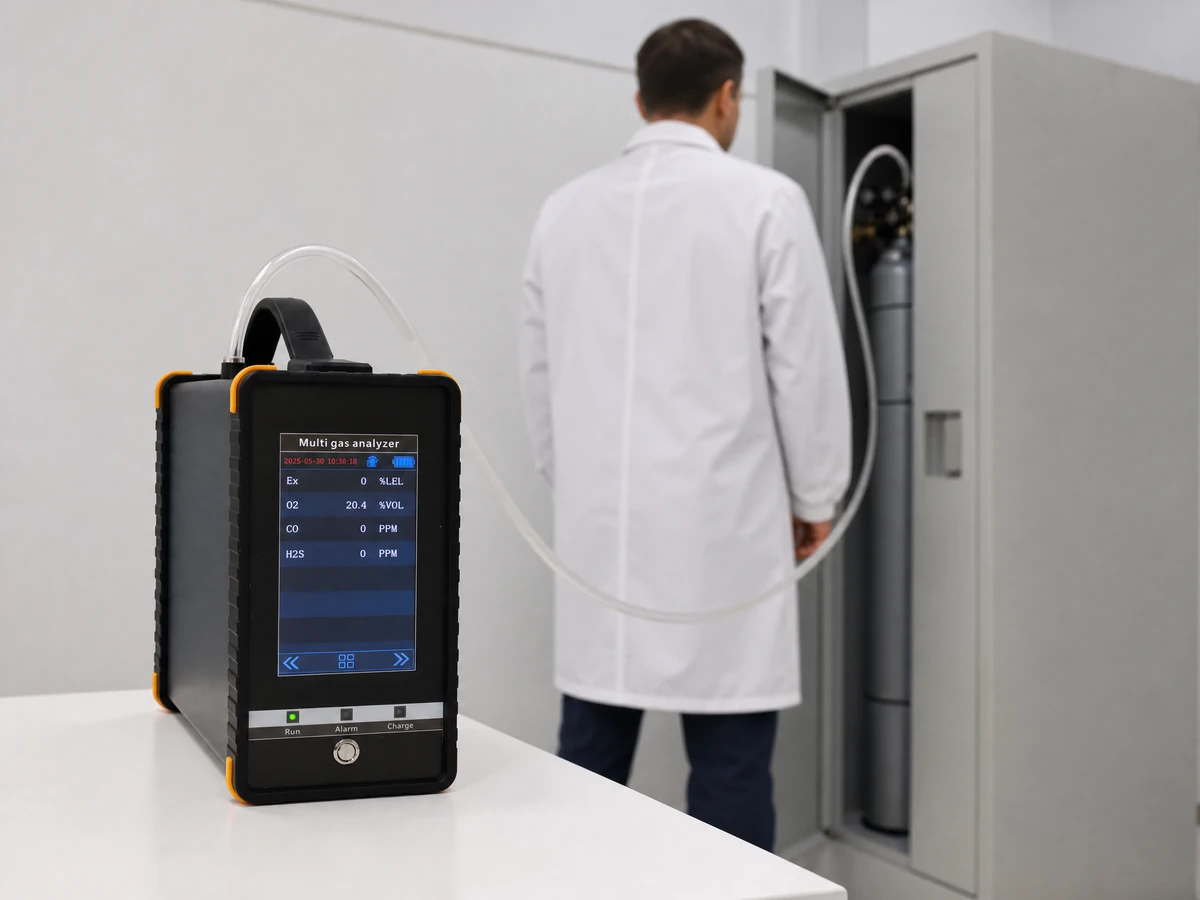
The OT800 brings a remote sample to the analyser for concentration review and comparison.
Configure the OT800 around the investigation task
The OT800 platform supports configurable multi-gas analysis. The installed gases, number of channels, sensor principles and measuring ranges must be confirmed for each project. A laboratory using hydrogen, oxygen and carbon dioxide needs a different configuration from one handling ammonia, hydrogen sulfide or sulfur dioxide.
Combining several sensors also requires a technical review. Sensor operating conditions, cross sensitivity and response time may differ. The final combination should reflect gases that may be present during the same event.
Sampling materials and timing affect the result
Gas must travel through the complete sample line before the display represents the remote point. Tubing length, pump flow, filters and sensor response all contribute to the waiting time. Some reactive or soluble gases can be weakened or delayed by unsuitable tubing and filters. The probe, line and any pretreatment components must be selected for the gas being measured.
The operator should purge the sample path between locations when required. Gas remaining in the tubing can influence the next measurement and make separate sample points appear more similar than they are.
The OT800 is an analysis instrument, not a wearable monitor
It is intended for pumped sampling, concentration review and leak investigation. It does not replace the G40S worn in the worker’s breathing zone. Many investigations require both instruments.
Personal monitoring
Keep the G40S in the worker’s breathing zone
Cylinder changes, regulator replacement and leak investigation bring the worker close to possible release points. The nearest fixed detector may be several metres away or separated from the person by a cabinet, bench or partition.
The G40S Portable Gas Detection Alarm uses natural diffusion and can monitor one to four gases simultaneously, with further configurations available. It should be clipped high on the worker’s clothing with its sensing openings exposed.
Audible, visual and vibration alarms warn the wearer when a configured condition occurs. Supported toxic-gas channels can use low, high, TWA and STEL modes when the facility has defined the correct settings.
The personal gas combination depends on the work. Hydrogen handling may call for combustible gas and oxygen monitoring. Work around toxic-gas cylinders requires sensors for the specific gases that could be released. A generic four-gas instrument is useful only when its sensors match the task.
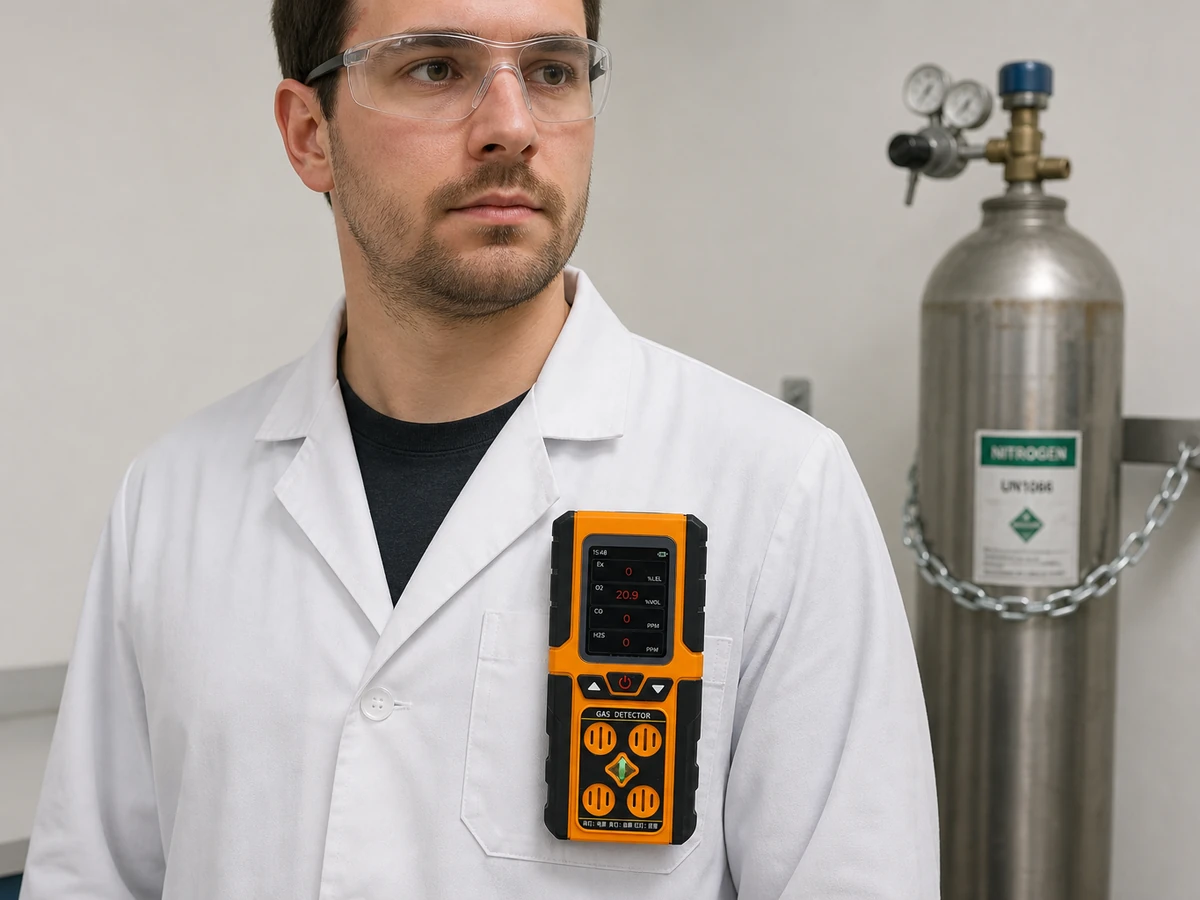
Personal monitoring follows the technician during cylinder handling and alarm investigation.
Alarm response
Define what happens before an alarm occurs
| System condition | Planning question | Possible site response |
| Low toxic or combustible gas alarm | Who investigates, and how will access be controlled? | Notify responsible staff, restrict access and assess the zone. |
| High toxic or combustible gas alarm | What evacuation, isolation and emergency notification are required? | Evacuate the zone and activate approved emergency controls. |
| Low oxygen alarm | Which inert-gas or cryogenic source may be involved? | Prevent entry, evacuate affected personnel and follow the response plan. |
| High oxygen alarm | How will the oxygen source and nearby ignition hazards be controlled? | Isolate the source where safe and control combustible materials. |
| Detector fault or lost signal | How will required monitoring coverage be restored? | Repair the point or introduce an approved temporary measure. |
Commissioning and maintenance
Test the complete path from detector to response
Commissioning should verify:
- Detector location, gas name, range and equipment tag
- Low and high alarm thresholds
- Local audible and visual alarm operation
- Controller channel identification and record storage
- Relay output and connected equipment response
- Loss of detector signal or communication
- Main and backup power behaviour
- Remote notification when that option is installed
The maintenance plan should cover visual inspection, inlet cleaning, functional testing, calibration and sensor replacement. Calibration gas must match the target sensor and required concentration. Portable equipment also needs battery, pump, alarm, filter and tubing checks before use.
Training should cover the limits of each instrument and the action required after an alarm. A technically correct reading has little value if the user does not know whether to withdraw, isolate the gas, call the emergency team or wait for further instructions.
Project information
What Otywell needs to configure the system
- Complete compressed-gas and cryogenic inventory
- Cylinder sizes and maximum quantities
- Cylinder room, cabinet and laboratory layouts
- Gas supply route from storage to point of use
- Room dimensions, normal occupancy and ventilation information
- Possible release points and operating pressures
- Required gases, measuring ranges and alarm modes
- Indoor environmental and hazardous-area conditions
- Detector signal and controller channel requirements
- Ventilation, warning and shutoff interfaces
- OT800 gas configuration and sampling accessories
- G40S quantities and personal monitoring gases
- Calibration gas and long-term maintenance arrangements
- Local code, certification and documentation requirements
The detector type and quantity can then be selected by zone. This avoids installing the same sensor package in every room regardless of the gases stored or used there.
Frequently asked questions
Laboratory gas detection FAQ
Which gases should a laboratory gas detection system monitor?</p
The system should monitor gases that can be released from the facility’s cylinders, generators, cryogenic equipment and experiments. Common requirements include hydrogen, combustible gas, oxygen, carbon dioxide, ammonia, hydrogen sulfide, sulfur dioxide and chlorine. Each sensor must be ordered for a named gas and measuring range.
Is an oxygen monitor enough for a nitrogen cylinder room?
Oxygen monitoring is commonly used to identify displacement caused by nitrogen, argon or helium. The sensor measures the reduction in oxygen, not the inert gas itself. Room volume, stored quantity, ventilation and possible release rate should be reviewed before the number and location of monitors are decided.
Can an oxygen detector be used instead of a carbon dioxide detector?
Equivalent protection should not be assumed. Carbon dioxide can create a direct exposure hazard before oxygen falls to the selected low-oxygen alarm level. Laboratories using or storing significant amounts of CO2 may require direct carbon dioxide detection.
Where should a hydrogen detector be installed?
Placement should consider the cylinder or generator, regulators, fittings, ceiling spaces, ventilation and possible accumulation paths. Hydrogen tends to rise, but room geometry and airflow still determine whether a release reaches the sensor.
Can the TCB2-F monitor four laboratory gases simultaneously?
The TCB2-F can be configured for one to four gases. The requested sensors must be checked for compatibility, measuring range and operating conditions. A four-sensor configuration is not suitable for every combination.
Why is the OT800 needed when fixed detectors are already installed?
Fixed detectors monitor their installed locations and identify the affected zone. The OT800 can draw samples from individual cabinets, supply connections, rooms or enclosed equipment. Its concentration display and real-time curves allow technicians to compare sample points during an investigation.
Does the G40S replace OT800 pumped sampling?
No. The G40S is a diffusion-based personal monitor worn near the breathing zone. The OT800 is a pump-sampled analyser used to collect and compare readings from chosen locations. An investigation may require the OT800 for analysis and the G40S for personal protection.
Can the GDB9 start ventilation or close a gas valve automatically?
The GDB9 provides configurable relay outputs that can transmit alarm signals to external systems. The ventilation or shutoff action must be designed and approved for the laboratory. The review should address experiments affected by power loss, airflow changes or automatic gas interruption.
Configure your laboratory system
Send us your gas list and laboratory layout
Otywell can configure detector gases, measuring ranges, controller capacity, signal outputs, OT800 sampling functions and personal monitors around the facility’s storage and working procedures.
Final detector locations, alarm settings, interlock actions and certification requirements must be reviewed against the actual site before installation.